Each quarter, we submit content to be considered for the SU Management Report to Senate and Council. We thought we’d also share here what the Language Centre has been up to during the last quarter (from the beginning of May to the end of July)!
[us_separator]
1. A thriving Stellenbosch University
Promoting institutional multilingualism at SU
Stellenbosch University (SU) is committed to developing and maintaining Western Cape regional languages Afrikaans and isiXhosa as academic languages, and to give support to SASL. Promoting a multilingual mindset among students and staff forms part of the initiative to humanise the institutional culture at SU. Recent activities through the Language Centre during the reporting period are reported on below.
Interpreting into three languages available at new Chancellor’s installation
SASL, isiXhosa and Afrikaans interpreters at the installation of SU’s new Chancellor.
Interpreting into isiXhosa, Afrikaans and South African Sign Language (SASL) was provided by the Language Centre at the installation of SU’s new Chancellor on 20 June. Lesetja Kganyago, Governor of the South African Reserve Bank, was formally installed as the institution’s 16th Chancellor, and has been serving in the position since January 2025. The installation ceremony took place at Endler Hall.
Interpreting at such high-profile events is an important element in welcoming a multilingual audience and acknowledging the worth of the languages used.
Say my name workshop
On 29 May 2025, the Language Centre successfully hosted the Say My Name workshop, attended by staff members from various departments/faculties. This engaging session aimed to create awareness around the importance of correct name pronunciation as a step towards mutual respect in multilingual spaces. Participants shared that the experience was enjoyable and meaningful, with lively interaction throughout. We hope that more staff will benefit from similar sessions in future.
Brand new Afrikaans Stylgids available to everyone at SU
The brand-new Afrikaans US Stylgids, aimed at SU staff and students, was released on 1 July and is available here. It is fitting for the Stylgids to be released in the year in which we celebrate the 100th anniversary of Afrikaans as an official SA language.
The Afrikaans Stylgids is intended as an accessible resource on Afrikaans language usage for the whole of the SU community and anyone else who chooses to use it. The guide aims to ensure that the language we use for the content and communication we provide on behalf of the University is consistent with the image of the University and consonant with our vision and identity as a university. The Stylgids therefore represents guidelines and house rules rather than a comprehensive set of universal grammar rules, and the preferences reflected in the guide are those of the institution.
Like its English counterpart, the SU Style Guide, the Afrikaans Stylgids was commissioned by the Corporate Communication and Marketing Division (CCMD) of the University and compiled by the SU Language Centre in a university-wide consultative process. The Stylgids is meant to be used in combination with the Brand Toolkit, which gives more guidance on the unified SU brand in terms of how we present the University visually and how we speak of it.
Exploring belonging through language: Staff workshop fosters connection and inclusion at SU
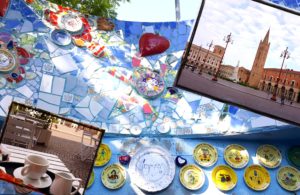
On 17 June, the Language Centre successfully hosted the first Zive usekhaya: Language and Belonging at Stellenbosch University workshop, attended by 15 staff members. This reflective session forms part of the Language Centre’s multilingual mindset series and offered participants a space to explore belonging, language, and identity through storytelling, discussion and beading. The workshop fostered connection, intercultural awareness and meaningful dialogue around inclusion in our multilingual campus culture. Similar workshops are lined up for students later this year to support their experiences of belonging at SU.
[us_separator size=”small”]
[us_image image=”33411″ align=”right”]
[us_image image=”33399″ align=”left”]
[us_image image=”33351″ align=”center”]
2. A transformative student experience
SU Language Centre Writing Lab activities during the first semester
The Language Centre’s Writing Lab strives to create a safe, friendly and caring space which provides personal support to students from different faculties and campuses. Between January and May, just over 1 391 writing consultations were conducted. The Writing Lab consults during exam time and vacation periods, during which consultations are primarily with postgraduate writers. Consultations are conducted in-person at the Writing Lab, or online via MS Teams, which accommodates distance students and any other student at the venue of their choice.
During the reporting period, the Writing Lab has had ongoing writing consultation collaborations with the following groups:
Agricultural Economics 478 and 781
Economics 214
Curriculum Studies (Afrikaans Home language 1st and 4th year students) (Education)
Entrepreneurship and Innovation Management
Political Science 114
Technical Communication Skills (Engineering)
Scientific Communication Skills (Science, in collaboration with the Language Centre)
MBA
Sustainable Development
Research Assignment 743 (Business Management).
In addition, the Writing Lab worked with lecturers and student writers who make contact independently.
Consultant training happens continuously throughout the year. During May, the Writing Lab collaborated with the Centre for Learning Technologies to explore the topic of artificial intelligence to help consultants to be prepared for consultations with students using AI in their writing. Consultants also study Writing Centre pedagogy and engage with the differences and similarities in various Writing Centres’ methodologies in terms of writing consultations. This sensitises consultants to the different needs of multilingual students from varying educational backgrounds.
Quality was enhanced this year through the use of electronic observation and evaluation forms for easy and effective data capturing. Observations form part of consultant training and involve consultants observing another consultant and giving feedback about their consultations. Student feedback about their consultation experience is used to ensure that students’ and lecturers’ specific needs and expectations are being addressed, and that all student writers and lecturers at SU have a positive experience working with the Writing Lab.
Campus Courses
The Language Centre kicked off the year with more than 50 students joining its interactive language courses: Campus isiXhosa and Campus Afrikaans. Offered in a relaxed and engaging environment, the courses are free to all students who are keen to grow their language skills, meet like-minded peers, and join a vibrant network of language learners on campus. Here’s what two of our recent participants had to say: “Being able to hold even a small conversation with isiXhosa speakers has been incredibly rewarding”, and “The energy in class and the positive, supportive atmosphere among new friends who all wanted to learn Afrikaans made the experience truly enjoyable.”
Presenter Nika Ndlela with a few of the isiXhosa course participants
Expanding access through South African Sign Language
In a significant step toward academic inclusion, the Language Centre, in partnership with the Faculty of Science, provided South African Sign Language (SASL) interpreting for a Deaf Honours student at the ISCB‑Africa ASBCB Conference on Bioinformatics, held from 14 to 17 April 2025, in Cape Town. The event, a gathering of researchers and students in computational biology, offered a rare opportunity for SASL interpreters to engage with specialised scientific terminology and discourse. The interpreting team described the experience as professionally enriching, underscoring the importance of inclusive access to high-level academic content. The Faculty of Science is commended for its proactive commitment to accessibility and for creating space for full academic participation in a highly specialised field.
[us_image image=”33489″]
[us_image image=”33447″]
The Language Centre has offered its South African Sign Language – Beginner Level A1 short course to 13 participants during the first semester. To enable participants who have completed the beginner course to expand their SASL knowledge further, a follow-up short course, South African Sign Language – Elementary Level A2, has been developed this year, and nine participants have completed the first offering.
In addition, a Teach South African Sign Language (SASL): Trainer short course has been developed and will be offered later during year. The course aims to equip first-language SASL users with the knowledge and skills to design, develop and teach a beginner SASL course to a broader audience. It introduces key elements of course creation, including basic structure and analysis, teaching methodology, assessment design and foundational business English.
3. Purposeful partnerships and inclusive networks
Internationalisation through multilingualism
SU is one of six global partner universities EUTOPIA associates with beyond its core alliance of 10 universities in Europe to create an international gateway for exchanging knowledge and culture. In May, Stellenbosch University was profiled as EUTOPIA’s University of the Month for its contribution to multilingualism through various activities on campus. In the feature article, Dr Kim Wallmach, Director of the Language Centre, comments:
[us_separator]
Stellenbosch – as a town and a campus – is a space where many conversations around identity, belonging and redress, intertwined as always with language, are taking place currently. One of the contributions SU can make […] is to provide a space where students from other countries can experience how a multilingual, yet divided, community is negotiating difference and finding commonalities.”
[us_separator]
The SU Language Centre has worked on developing courses and partnerships to enhance the experiences of international students visiting SU and on building student communities through a multilingual mindset. Some recent initiatives were:
University of Georgia Students learn Afrikaans and isiXhosa
In May, the Language Centre had the privilege of hosting a group of 16 students from the University of Georgia (USA) for a short language acquisition course in Afrikaans and isiXhosa. The students thoroughly enjoyed the opportunity to engage with both languages and gain a brief but meaningful introduction to the linguistic and cultural diversity of our region. The Language Centre looks forward to welcoming the University of Georgia again in future and continuing to share the richness of Afrikaans and isiXhosa language and culture with international visitors.
Afrikaans language and culture course for Dutch-speaking students celebrates 10 years
The Language Centre’s celebrated 10 years of language and cultural learning at the end of the first semester this year. This milestone is being celebrated with a series of social media and blog posts shared on the LC’s social media platforms in collaboration with SU International.
A highlight included an interview with Sen Joostens, a former student from Belgium who is currently facilitating Afrikaans language learning at KU Leuven. Over the years, the course has drawn more than 200 students from Belgium and the Netherlands.
Stellenbosch University expands its partnerships with Côte d’Ivoire
The Language Centre hosted a group of 28 students from the Institut National Polytechnique Félix Houphouët-Boigny (INP-) INP-HB (Côte d’Ivoire) from 4 July until 1 August. This is the fourth cohort since 2023 and the second cohort for 2025. The students are master’s level students aiming to improve their general and business English skills. Previous students have commented that one of the benefits of coming to SU is the opportunity for immersion, where they are able to use English in everyday interactions in and around Stellenbosch to enhance their communicative competence.
Then, in a new collaboration with the Chamber of Commerce and Industry of Côte d’Ivoire, a group of 9 participants has completed a two-week block of the Intensive English Programme (IEP) at the Language Centre from 4 to 18 July. These students are professionals from the language department from the Chamber of Commerce. This collaboration was initiated by the 1st Secretary (Department of International Relations and Cooperation (DIRCO)) of the South African Embassy in Abidjan, Côte d’Ivoire.
IEP students and their teacher (Ammie) in the classroom
In addition, fifteen international students (from Germany, South Korea, Japan, Madagascar, DRC, Benin, Saudi Arabia, Russia and Italy) enrolled for Intensive English Programme blocks during June and July.
The Language Centre offered bespoke creative writing workshops in English, Afrikaans, and isiXhosa to a cohort of 15 participants in the first semester on-site at Hazendal wine estate.
One of the main aims of the workshops was to upskill and empower the Hazendal staff at various levels, and to bring the team together.
Estelle Meima of the University of Groningen and Vernita Beukes of the SU Language Centre, presenters of the Intercultural Group Dynamics module in the EQUiiP Summer school in Groningen.
Dr Vernita Beukes, a lecturer at the Language Centre, was part of an international panel of five who presented the EQUiiP Summer School at the University of Groningen in the Netherlands from 16 to 20 June this year. The EQUiiP programme is a collaborative summer school that encourages peer learning and sharing teaching practices to professionally develop practitioners. Participants hailed from Iran, Croatia, Latvia, South Africa and the Netherlands, which gave both presenters and participants the opportunity to network with educators from around the world.
The programme explored the concept of internationalising the curriculum, identified effective strategies for creating inclusive classrooms, and developed practical skills on utilising the principles of universal design for learning to meet the diverse needs of students.
The diverse backgrounds and experiences of the participants enriched the discussions and provided multiple perspectives on the challenges and opportunities of internationalising curriculum and creating inclusive classrooms. Collaborative activities and group discussions facilitated the exchange of ideas and best practices, fostering a sense of community and mutual support.
5. Research for impact
The Language Centre does ongoing targeted research to inform best practice.
6. Employer of choice
Strengthening intercultural practice in language teaching
Colleagues involved in teaching Afrikaans and isiXhosa at the Language Centre participated in a two-part professional development series focused on the book Developing the Intercultural Dimension in Language Teaching (Council of Europe, 2002). The sessions, held in March and June 2025, created a space for staff to engage critically with foundational concepts and practical strategies for fostering intercultural competence in multilingual classrooms. Presenters and participants reflected on how these ideas resonate within the South African context and shared insights grounded in current teaching practice.
Language Centre Comms Lab short course offerings strengthen professional communication at SU
The Language Centre’s Comms Lab has continued its efforts to streamline professional communication at SU during the reporting period. Courses presented include:
The Deputy Director of Internal Communications from the Department of Planning, Monitoring and Evaluation in the Presidency, Tshwane, was one of the participants attending this course. Staff from Student Recruitment, Maties Gymnasium and other environments also attended.
The popular course was presented on 20 and 21 May. A total of 13 participants, six marketing experts from table grape exporter EXSA, and staff from Residence Services, Corporate Communication and Marketing Division, Bureau for Economic Research and the Language Centre, attended the course.
Some feedback: “Excellent course. Surpassed my expectations. Good balance of theory and practical application. Constructive feedback at all times. As facilitator, Eduard created a safe space in which to learn. Perfect and enough to cover the content. There was nothing to fault with this course. Will highly recommend it.”
Five staff members and two external professionals, a medical doctor with her own practice and a senior superintendent from City of CT Municipality, attended this course during May and June. This is what one of our participants had to say:
[us_separator]
Great course, the presenter made everyone feel part and comfortable to share. It gave me confidence and the feedback on assignments were valuable.”
Contributors:
Vernita Beukes
Arné Binneman
Sanet de Jager
Bongiwe Dlutu
Fatima Halday
Christine Joubert
Anne-Mari Lackay
Susan Lotz
Andréa Müller
Helga Sykstus
Kim Wallmach
René Wheeler
Ons dien kwartaalliks inligting in vir moontlike plasing in die Universiteit Stellenbosch (US) se Bestuursverslag aan die Senaat en Raad. Ons vertel graag ook hier waarmee die Taalsentrum in die laaste kwartaal, van die begin van Mei tot die einde van Julie, besig was.
[us_separator]
1. ’n Florerende Universiteit Stellenbosch
Die bevordering van institusionele meertaligheid by die US
Die SU het hom daartoe verbind om die Wes-Kaapse streektale, Afrikaans en Xhosa, as akademiese tale te ontwikkel en te onderhou, en om die Suid-Afrikaanse Gebaretaal (SASL) te ondersteun. Die bevordering van ʼn meertalige ingesteldheid onder studente en personeel maak deel uit van die inisiatief om die institusionele kultuur aan die US te vermenslik. Ons doen hier onder verslag oor die Taalsentrum se bedrywighede in die tweede kwartaal van 2026.
Tolking in drie tale tydens die nuwe Kanselier se inhuldiging
SASL-, Xhosa- en Afrikaanstolke by die inhuldiging van die US se nuwe Kansellier
Die Taalsentrum het tydens die inhuldiging van die US se nuwe Kanselier op 20 Junie tolking in Xhosa, Afrikaans en Suid-Afrikaanse Gebaretaal (SASL) voorsien. Lesetja Kganyago, Goewerneur van die Suid-Afrikaanse Reserwebank, is amptelik ingehuldig as die instansie se 16de Kansellier, nadat hy reeds sedert Januarie 2025 in daardie amp dien. Die inhuldigingseremonie het in die Endlersaal plaasgevind.
Tolking by sulke hoëprofielgeleenthede is ʼn belangrike aspek van die verwelkoming van ʼn meertalige gehoor en van die erkenning van die waarde van die tale wat gebruik word.
Say My Name-werksessie
Die Taalsentrum het op 29 Mei 2025 die Say My Name-werksessie, wat deur personeel van verskeie departemente en fakulteite bygewoon is, met groot sukses aangebied. Die doel daarvan was om bewustheid van die korrekte uitspraak van name te verskerp as ʼn stap in die rigting van wedersydse respek in meertalige ruimtes. Die deelnemers het laat weet dat dié ervaring genotvol en betekenisvol was en dat daar deurgaans lewendige deelname was. Ons hoop dat meer personeel in die toekoms by soortgelyke sessies sal baat.
Splinternuwe Afrikaanse Stylgids vir almal by US beskikbaar
Die US se splinternuwe Afrikaanse Stylgids, gemik op US-personeel en studente, is op 1 Julie vrygestel en is hier beskikbaar. Dit is heel gepas dat die Stylgids die lig sien in die jaar waartydens ons die 100ste bestaansjaar van Afrikaans as ʼn amptelike Suid-Afrikaanse taal vier.
Die Stylgids vir Afrikaans is bedoel om ʼn toeganklike hulpbron te wees oor die gebruik van Afrikaans vir die hele US-gemeenskap en enige iemand anders wat dit wil gebruik. Ons hoop dat hierdie gids sal verseker dat die taal wat ons gebruik om namens die Universiteit inligting oor te dra en te kommunikeer, by die US se beeld pas en ooreenstem met ons visie en identiteit as ʼn universiteit. Derhalwe bevat die Stylgids riglyne en interne reëls eerder as ʼn volledige stel universele grammatikareëls, en die voorkeure wat in die Stylgids weerspieël word, is dié van die instansie.
Net soos sy Engelse eweknie, die SU Style Guide, is die Stylgids vir Afrikaans deur die Universiteit se Afdeling Korporatiewe Kommunikasie en Bemarking aangevra en ná ʼn konsultasieproses waarby die hele US betrek is, deur die Taalsentrum saamgestel. Die Stylgids moet saam met die Handelsmerkgereedskapstel gebruik word, wat meer leiding verskaf oor die eenvormige US-handelsmerk se toepassing in die manier waarop ons die Universiteit visueel aanbied en hoe ons daarvan praat.
ʼn Skermskoot van ʼn bladsy in die Stylgids vir Afrikaans
Verkenning van geborgenheid deur taal: Personeelwerksessie bevorder verbintenis en insluiting by US
Op 17 Junie het die Taalsentrum die eerste Zive usekhaya: Language and Belonging at Stellenbosch University-werksessie, wat deur 15 personeellede bygewoon is, suksesvol aangebied. Hierdie sessie wat ruimte bied vir nadenke maak deel uit van die Taalsentrum se meertalige ingesteldheid-reeks. Die inisiatief het aan deelnemers ʼn ruimte gebied om hulle tuishoortgevoel te versterk en taal en identiteit te verken deur stories te vertel, en deur besprekings en kralewerk. Die werksessie het verbintenis, interkulturele bewustheid en betekenisvolle dialoogvoering oor insluiting by ons meertalige kampuskultuur bevorder. Soortgelyke werksessies vir studente word vir later vanjaar beplan om hulle ervarings daarvan om by die US tuis te hoort, te versterk.
[us_separator size=”small”]
[us_image image=”33411″ align=”right”]
[us_image image=”33399″ align=”left”]
[us_image image=”33351″ align=”center”]
2. ʼn Transformerende studente-ervaring
Die US Taalsentrum se Skryflabaktiwiteite in die eerste semester
Die Taalsentrum se Skryflab het dit ten doel om ʼn veilige, vriendelike omgeeruimte te skep wat persoonlike ondersteuning bied aan studente van verskillende fakulteite en kampusse. Tussen Januarie en Mei het net meer as 1 391 skryfkonsultasies plaasgevind. Die Skryflab konsulteer in eksamentye en gedurende vakansies, wanneer konsultasies hoofsaaklik met nagraadse skrywers is. Konsultasies vind van aangesig tot aangesig in die Skryflab plaas, of aanlyn in MS Teams met afstandstudente en enige ander studente op die plek van hul keuse.
Gedurende die verslagtydperk het die Skryflab deurlopend deur skryfkonsultasies met die volgende groepe saamgewerk:
Landbou-ekonomie 478 en 781
Ekonomie 214
Kurrikulumstudies (Afrikaans Huistaal eerstejaar- en vierdejaarstudente) (Opvoedkunde)
Entrepreneurskap en Innoveringsbestuur
Politieke Wetenskap 114
Tegniese Kommunikasievaardighede (Ingenieurswese)
Wetenskaplike Kommunikasievaardighede (Natuurwetenskappe, in samewerking met die Taalsentrum)
MBA
Volhoubare Ontwikkeling
Navorsingsopdrag 743 (Sakebestuur)
Dan het die Skryflab ook gewerk met dosente en studenteskrywers wat onafhanklik navraag gedoen het.
Die Skryflab lei konsultante deurlopend op. In Mei het die Skryflab met die Sentrum vir Leertegnologieë saamgewerk om die konsep van kunsmatige intelligensie (KI) te ondersoek ten einde konsultante te help om voorbereid te wees wanneer hulle konsultasies het met studente wat KI in hulle skryfwerk gebruik. Konsultante bestudeer ook skryfsentrumpedagogiek en die verskille en ooreenkomste tussen verskillende skryfsentrums se metodologieë wat betref skryfkonsultasies. Dit maak konsultante sensitief vir die verskillende behoeftes van meertalige studente uit verskillende opvoedkundige agtergronde.
Gehalte is vanjaar verbeter deur die gebruik van elektroniese waarnemings- en evalueringsvorms vir maklike en effektiewe datavaslegging. Waarnemings maak deel uit van konsultante se opleiding en behels dat konsultante mekaar waarneem en terugvoer oor mekaar se konsultasies gee. Studente se terugvoer oor hul konsultasie-ervarings word gebruik om te verseker dat daar in studente en dosente se spesifieke behoeftes voorsien word, en dat dit vir alle studenteskrywers en dosente aan die US ʼn positiewe ervaring is om met die Skryflab te werk.
Kampuskursusse
Die Taalsentrum het die jaar afgeskop met meer as 50 studente wat ingeskryf het vir die interaktiewe taalkursusse, Kampus-Xhosa en Kampusafrikaans. Hierdie kursusse word gratis aangebied vir alle studente wat hulle taalvaardighede graag wil verbeter, en word in ʼn ontspanne en stimulerende omgewing aangebied waar studente enersdenkende eweknieë kan ontmoet en by ʼn dinamiese netwerk van taalleerders op die kampus kan aansluit. Twee van ons onlangse deelnemers het dit só gestel: “Dit was ʼn ongelooflike ervaring om in staat te wees om selfs net ʼn kort gesprekkie met Xhosa-sprekers te voer”, en “Die energie in die klas en die positiewe, ondersteunende atmosfeer tussen nuwe vriende wat almal Afrikaans wil leer, het vir ʼn werklik genotvolle ervaring gesorg.”
Aanbieder Nika Ndlela met ʼn paar van die deelnemers aan die Xhosa-kursus
Die uitbreiding van toegang deur Suid-Afrikaanse Gebaretaal
In ’n betekenisvolle stap na akademiese insluiting het die Taalsentrum, in vennootskap met die Fakulteit Natuurwetenskappe, by die ISCB‑Africa ASBCB-konferensie oor Bioinformatika, wat van 14 tot 17 April 2025 in Kaapstad plaasgevind het, tolking in Suid-Afrikaanse Gebaretaal (SASL) voorsien aan ’n Dowe honneursstudent. Hierdie geleentheid, wat navorsers en studente in rekenaarbiologie byeengebring het, het ’n seldsame geleentheid gebied vir SASL-tolke om betrokke te raak by gespesialiseerde wetenskaplike terminologie en diskoers. Die span tolke, wat as van die beste in Suid-Afrika beskou word, het die ervaring as professioneel verrykend beskryf en die belangrikheid van inklusiewe toegang tot akademiese inhoud op hoë vlak beklemtoon. Die Fakulteit Natuurwetenskappe word geloof vir sy proaktiewe toewyding tot toegang en vir die skep van ruimte vir volle akademiese deelname in ’n hoogs gespesialiseerde veld.
[us_image image=”33489″]
[us_image image=”33447″]
Die Taalsentrum het in die eerste semester die -kortkursus vir 13 deelnemers aangebied. Om deelnemers wat die beginnerskursus voltooi het in staat te stel om hul SASL-kennis verder uit te brei, is ’n opvolgkortkursus, SASL – Elementêre vlak A2, vanjaar ontwikkel en nege deelnemers het die eerste aanbieding voltooi.
Nog ʼn kortkursus, die SASL-Opleierskursus, is ontwikkel en sal later vanjaar aangebied word. Dié kursus is daarop gemik om eerstetaalgebruikers van SASL toe te rus met die kennis en vaardighede om ʼn beginnerskursus in SASL vir ’n breër gehoor te ontwerp, te ontwikkel en aan te bied. Dit stel kernkomponente van kursusontwikkeling bekend, met inbegrip van basiese struktuur en analise, onderrigmetodologie, assesseringsontwerp en grondbeginsels van sake-Engels.
3. Doelgerigte vennootskappe en inklusiewe netwerke
Internasionalisering deur meertaligheid
Die US is een van ses wêreldwye vennootuniversiteite waarmee EUTOPIA – buiten sy kernalliansie van tien Europese universiteite – saamwerk om ’n internasionale ruimte vir die uitruil van taal- en kultuurkennis te skep. In Mei is die US aangewys as EUTOPIA se Universiteit van die Maand danksy die instansie se bevordering van meertaligheid deur verskeie aktiwiteite op kampus. In die hoofartikel het dr Kim Wallmach, Direkteur van die Taalsentrum, opgemerk:
[us_separator]
Stellenbosch – as ʼn dorp en as ʼn kampus – is ʼn plek waar baie gesprekke tans plaasvind oor identiteit, ʼn tuishoortgevoel en regstelling; vervleg met taal, soos altyd. Een van die bydraes wat die US kan maak […], is om ʼn ruimte te voorsien waar studente van ander lande kan ervaar hoe ’n meertalige, dog verdeelde, gemeenskap oor verskille onderhandel en ooreenkomste vind.”
[us_separator]
Deur die bevordering van ʼn meertalige ingesteldheid werk die Taalsentrum aan die uitbou van studentegemeenskappe, asook aan die ontwikkeling van kursusse en vennootskappe om die ervarings van internasionale studente wat die US besoek, te verbeter. Onlangse inisiatiewe sluit in:
Studente van die Universiteit van Georgia leer Afrikaans en Xhosa
In Mei het die Taalsentrum die voorreg gehad om ʼn groep van 16 studente van die Universiteit van Georgia in die VSA te ontvang vir ʼn kort taalverwerwingskursus in Afrikaans en Xhosa. Die studente het dit terdeë geniet om met dié twee tale om te gaan en ’n kort maar betekenisvolle kennismaking met die taalkundige en kulturele diversiteit van ons streek te beleef. Die Taalsentrum sien uit daarna om die Universiteit van Georgia weer in die toekoms te verwelkom en om die rykdom van Afrikaans en Xhosa – die tale en kulture – verder met internasionale besoekers te deel.
Afrikaanse taal- en kultuurkursus vir Nederlandssprekende studente vier tien jaar
Die Taalsentrum se Afrikaanse taal- en kultuurkursus vir Nederlandssprekende studente het aan die einde van die eerste semester vanjaar tien jaar se taal- en kultuurleer gevier. Hierdie mylpaal word gevier met ʼn reeks sosialemedia- en blogplasings op die Taalsentrum se sosialemediaplatforms in samewerking met US Internasionaal.
ʼn Hoogtepunt was ʼn onderhoud met Sen Joostens, ʼn oudstudent uit België wat studente van die KU Leuven tans ondersteun om Afrikaans te leer. Deur die jare het reeds meer as 200 studente uit België en Nederland die kursus bygewoon.
Die Universiteit Stellenbosch brei sy vennootskap met die Ivoorkus uit
Tussen 4 Julie en 1 Augustus het ʼn groep van 28 meestersgraadstudente van die Institut National Polytechnique Félix Houphouët-Boigny (INP-HB) in die Ivoorkus die Taalsentrum besoek. Dit was die vierde groep sedert 2023 en die tweede groep in 2025. Die doel van hulle besoek was om hulle vaardigheid in algemene en sake-Engels te verbeter. Vorige studente het genoem dat een van die voordele van hulle verblyf by die US die geleentheid was om dikwels Engels te praat – hulle kon in hulle daaglikse handel en wandel in en om Stellenbosch Engels praat en sodoende leer om veel beter in Engels te kommunikeer.
As deel van ʼn nuwe samewerkingsooreenkoms met die Kamer van Koophandel van die Ivoorkus sal ʼn groep van nege lede van 4 tot 18 Julie ʼn Intensiewe Engels-program (IEP) van twee weke deurloop. Hierdie studente is professionele lede van die Kamer van Koophandel se taaldepartement, en hierdie ooreenkoms is deur die Eerste Sekretaris van die Departement Internasionale Betrekkinge en Kommunikasie (DIRCO) van die Suid-Afrikaanse Ambassade in Abidjan in die Ivoorkus geïnisieer.
IEP-studente en hulle onderwyser (Ammie) in die klaskamer
Verder het 15 internasionale studente (uit Duitsland, Suid-Korea, Japan, Madagaskar, DRK, Benin, Saudi- Arabië, Rusland en Italië) in Julie ingeskryf vir IEP-blokke.
Drietalige kreatieweskryfwerksessies vir personeel van Hazendal-wynlandgoed
In die eerste semester het die Taalsentrum doelgemaakte werksessies vir kreatiewe skryf in Engels, Afrikaans en Xhosa op die Hazendal-wynlandgoed vir ʼn groep van 15 deelnemers aangebied.
Een van die hoofdoelstellings van die werksessies was om die Hazendal-personeel se vaardighede op verskeie vlakke op te skerp en hulle te bemagtig, en om hulle samehorigheidsgevoel as ʼn span te versterk.
Estelle Meima van die Universiteit van Groningen en Vernita Beukes van die SU se Taalsentrum, aanbieders van die Interkulturele Groepsdinamika-module by die EQUiiP-somerskool in Groningen.
Dr Vernita Beukes, ʼn dosent by die Taalsentrum, was een van die vyf lede van ʼn internasionale paneel wat die EQUiiP-somerskool aan die Universiteit van Groningen van 16 tot 20 Junie vanjaar aangebied het. Die EQUiiP-program is ʼn samewerkende somerskool wat eweknieleer en die deel van onderrigpraktyke aanmoedig vir die professionele ontwikkeling van praktisyns. Deelnemers het van Iran, Kroasië, Letland, Suid-Afrika en Nederland gekom, wat aan sowel aanbieders as deelnemers die geleentheid gebied het om met opvoeders van regoor die wêreld te netwerk.
Die program het gefokus op die internasionalisering van die kurrikulum, die identifisering van effektiewe strategieë om inklusiewe klaskamers te skep, en die ontwikkeling van praktiese vaardighede om die beginsels van universele ontwerp vir leer te gebruik om in studente se uiteenlopende behoeftes te voorsien.
Die uiteenlopende agtergronde en ervarings van die deelnemers het die besprekings verryk en veelvoudige perspektiewe verskaf op die uitdagings en geleenthede in die internasionalisering van leerplanne en die skep van inklusiewe klaskamers. Samewerkende aktiwiteite en groepbesprekings het die uitruil van gedagtes en beste praktyke gefasiliteer, en ʼn gemeenskapsgevoel en wedersydse ondersteuning bevorder.
5. Navorsing vir impak
Die Taalsentrum doen deurlopend geteikende navorsing om beste praktyk toe te pas.
6. Voorkeurwerkgewer
Verbetering van interkulturele praktyke in taalonderrig
Kollegas wat betrokke is by die onderrig van Afrikaans en Xhosa by dieTaalsentrum het aan ’n tweedelige professionele ontwikkelingsreeks deelgeneem wat gefokus het op die boek, Developing the Intercultural Dimension in Language Teaching (Council of Europe, 2002). Die sessies, aangebied in Maart en Junie 2025, het ruimte geskep vir personeel om krities in gesprek te tree met grondliggende konsepte en praktiese strategieë om interkulturele bevoegdheid in meertalige klaskamers te bevorder. Aanbieders en deelnemers het nagedink oor hoe hierdie idees met die Suid-Afrikaanse konteks resoneer, en insigte gedeel wat in huidige onderrigpraktyke gegrond is.
Taalsentrum se Kommunikasielab-kortkursusse versterk professionele kommunikasie by die US
Die Taalsentrum se Kommunikasielab het in die verslagtydperk voortgegaan met sy werk om professionele kommunikasie aan die US meer vaartbelynd te maak. Een van die kortkursusse wat aangebied is, is:
Die Adjunkdirekteur van Interne Kommunikasie by die Departement van Beplanning, Monitering en Evaluering in die Presidensie, Tshwane, was een van die deelnemers aan hierdie kursus. Personeel van Studentewerwing, Maties Gimnasium en ander omgewings het dit ook bygewoon.
Hierdie gewilde kursus is op 20 en 21 Mei aangebied. ʼn Totaal van 13 deelnemers, ses bemarkingskundiges van die tafeldruifuitvoerder EXSA, en personeel van Koshuisdienste, die Afdeling Korporatiewe Kommunikasie en Bemarking, die Buro vir Ekonomiese Navorsing en die Taalsentrum het dit bygewoon.
Terugvoer wat ontvang is: “Uitstekende kursus wat my verwagtinge oortref het met die goeie balans tussen teorie en praktiese toepassing. Die terugvoer was altyd konstruktief, en as fasiliteerder het Eduard ʼn veilige ruimte geskep waar ons kon leer met genoeg tyd om die inhoud te dek. Ek kon geen fout vind met hierdie kursus nie en beveel dit sterk aan.”
Vyf personeellede en twee eksterne professionele persone, ʼn mediese dokter met haar eie praktyk en ʼn senior superintendent van die Stad Kaapstad se munisipaliteit, het hierdie kursus in Mei en Junie bygewoon. Een van ons deelnemers het die volgende te sê gehad daaroor:
[us_separator]
Uitstekende kursus. Die aanbieder het almal deel van die groep laat voel en dit vir ons maklik gemaak om te deel. Dit het my selfvertroue gegee, en die terugvoer oor werkopdragte was waardevol.”
Bydraers:
Vernita Beukes
Arne Binneman
Sanet de Jager
Bongiwe Dlutu
Fatima Halday
Christine Joubert
Anne-Mari Lackay
Susan Lotz
Andréa Müller
Helga Sykstus
Kim Wallmach
René Wheeler
The Language Centre will be visited by an English language specialist from America in 2023!
On Friday 28 October, two staff members from the Language Centre (LC), Dr Arné Binneman and Dr Rose Richards had the privilege of meeting members of the American Embassy’s Regional English Language Office (RELO) and giving them a tour of our beautiful campus. We were visited by Dr Bradley Horn, Francinah Magoro and Dr Alice King.
The reason for the visit was to plan for an English language specialist to join the LC via the Regional English Language Office for a period in 2023. The United States Embassy’s Regional English Language Office’s English Language Specialist Program recruits United States specialists in the areas of English language teaching and applied linguistics for short-term assignments abroad. These assignments may include curriculum projects, teacher training seminars, textbook development, English for Specific Purposes and program evaluation.
The specialist will be involved in the LC’s part of the university-wide assessment project, ‘Assessment matters: Re-imagining assessment culture and practices for a transformative student experience’. The project was mooted against the background of the challenges that Covid-19 created for student assessment across all sectors of education and the resultant need for new ways of assessment to be investigated. The project is run through the Division for Learning and Teaching Enhancement, of which the LC forms part.
The LC’s part of the project involves developing an equivalent post-instruction test for the LC elementary short courses in English, Afrikaans and isiXhosa. The project will also involve using data from LC Writing Centre consultations to develop faculty-specific tests of academic literacies across the faculties of AgriSciences, Economic and Management Sciences, and Engineering. In both these cases, research will be carried out on the definition of the language constructs to be measured and the usefulness of these tests once they have been piloted. We’re looking forward to hosting the specialist in 2023.
Pictured from left to right: Dr Alice King (EducationUSA Adviser and Outreach Specialist), Dr Arné Binneman (lecturer and coordinator, Stellenbosch University Language Centre), Francinah Magoro and Dr Bradley Horn (Director, American Embassy’s Regional Language Office).
Get to know us through the books we read! This month we chat to Selene Delport, coordinator of writing skills workshops for postgrad students at the Writing Lab.
Selene joined the Writing Lab as a consultant in 2006. In 2009, she started conducting its writing skills workshops for postgraduate students. “My work at the Writing Lab has afforded me the privilege of travelling to various countries – among others Kenya, Uganda, Tanzania, Ghana, Eswatini and Lesotho. Each country I’ve visited holds a piece of my heart. The Writing Lab, as a liminal and transformative space, has taught me so much,” she says of her workplace. “In particular, I’ve learnt how to help students navigate sometimes very restrictive and silencing institutional structures, without becoming complicit in those structures myself.”
What is the title of your favourite book, or a book that had a great impact on you? That’s a terrible thing to ask a reader. 😅
I’ve always loved reading. Some of my favourite children’s books are Matyn die Stermannetjie (Lochner de Kock), Huppelkind (WO Kühne), and Grobbelaartjie van Velskoendorp (Oscar Prozesky). I still have most of my children’s books and they look a bit worse for wear from being lovingly read and reread over decades.
As an adult, I’ve kept my love for children’s stories. I still regularly reread Alice in Wonderland (Lewis Carroll) and The Wind in the Willows (Kenneth Grahame). And, of course, I love fantasy (JRR Tolkien, Terry Pratchett, Neil Gaiman) and young adult fiction. I think fantasy and young adult (YA) fiction are often underappreciated, especially YA fiction written by African writers. Two of my favourite YA fiction/fantasy authors are Tochi Onyebuchi and Lily Herne.
Onyebuchi is a Nigerian author who wrote Beasts Made of Night. It tells the story of Taj, who is an ‘aki’ – someone from the lower classes who is hired to devour the sins of the upper class so that they can live guilt-free. Beasts Made of Night is one of those books where I had to take a bit of time before being able to start reading the next book. Onyebuchi’s characterisation of Taj makes it impossible for readers not to connect with Taj on a deep emotional level. I’m eagerly awaiting the sequel, Crown of Thunder.
Lily Herne is the pen name of a mother/daughter writing duo. They wrote the Deadlands saga set in a post-apocalyptic, zombie-infested South Africa. I’ve finished the first three books and am desperately looking for the last book, Ash Remains. (If someone knows where I can buy or borrow a copy, please let me know!)
Why did this book make such an impression on you? All these books, and many others, have left a lasting impression on me. The reasons are varied – some of them give readers glimpses into the lives of people or characters who usually would not get platforms in canonical works or public spaces; some of them are just enjoyably weird.
One book that made quite an impression on me is Musrum. It’s by far the weirdest book I’ve read. It is a British publication, written by Erick Thacker, a Methodist minister, and Anthony Earnshaw, an artist, art teacher and also an atheist. The book came about by them exchanging letters. The book also contains a lot drawings – some with religious themes, others containing symmetrical patterns and some even in the form of maps. The lettering and meaning of Musrum keep changing. (The picture on the opening page gives you an idea of how wonderfully strange the book is.) I’m still not sure if Musrum is a brilliant masterpiece or just delightful nonsense.
Opening page, Musrum.
Who is (are) your favourite author(s)? Also tell us why? Again, there are several! One of my favourite authors is Yvonne Vera. Her poetic prose voices unspeakable traumas: violent liberation wars and their aftermath in Nehanda and The Stone Virgins; the horrifying loss of a child in Without a Name; and brutal violence against women in Under the Tongue and Butterfly Burning. But her stories also foreground the resilience that people can have.
What are you reading at the moment? I’m reading something light at the moment – Fiona Snyckers’ The Cat That Had a Clue. It’s the first book in a series called The Cat’s Paw Cozy Mysteries. The stories are Agatha Christie-like whodunnits with lots of cats in it.
Do you have a preference: reading physical books with paper pages or on a Kindle or other electronic platform? Why do you say so? I enjoy both. There’s nothing better than the feel and smell of a physical book, but it’s so much more comfortable reading a Kindle book in bed.
Who is your favourite literary character? There are many: Gandalf from Tolkien’s Lord of the Rings, Alice from Carroll’s Alice in Wonderland, Grace from Atwood’s Alias Grace, and Tiffany Aching from Pratchett’s Discworld novels. I think I like them so much because their identities are never really fixed; they’re constantly evolving and changing – sometimes heroically, sometimes in unsettling ways.
Have you perhaps learnt a life lesson from a book or character that you would like to share with us (if this hasn’t come up in one of your answers already)? The best advice ever comes from Douglas Adams’ The Hitchhiker’s Guide to the Galaxy: “A towel … has great practical value”.
But jokes aside, a life-changing book is Sheldon B. Kopp’s If You Meet the Buddha on the Road, Kill Him! The Pilgrimage of Psychotherapy Patients. What resonated most with me is Kopp’s description of situational ethics:
[us_hwrapper]
Rules will come to serve as tentative guidelines. Each act will have to be judged as a personal experience, in terms of its existential meaning, rather than by checking it out against a rule carved on a stone tablet long ago and far away.”
[/us_hwrapper]
What book/books would you recommend to your students, friends or anyone else? My recommendation is to read any books you want, but to read widely. Chimamanda Ngozi Adichie warns us against the “danger of the single story”. Reading widely saves us from the “incomplete” stories about other people and other places, it helps us recognise “our equal humanity” and “regain some kind of paradise”.
Stellenbosch University (SU) aims to be Africa’s leading research-intensive University, and here at the SU Language Centre we produce knowledge of, in and for Africa.
The Language Centre has a robust cohort of researchers, and just like staff from academic departments, we do research on various topics within our field to generate new knowledge. “We publish our research as journal articles, chapters in books and research reports, and present our findings at conferences,” explains Dr Rose Richards, head of the SU Language Centre’s Writing Lab and Research.
[us_hwrapper]
We perform different types of behind-the-scenes research ‘service’ work – for example, examining theses and dissertations, supervising postgraduate students’ research, and reviewing submissions for a wide range of academic journals.”
[/us_hwrapper]
Rose also serves on one of SU’s Health Research Ethics Committees (HREC 1) — they can review over 40 proposals in one meeting and in their last one, they reviewed 49!
Here are some of our research interests at the Language Centre. Feel free to get in touch with our researchers to learn more about our latest research.
What is the future of South African Sign Language interpreting? (Contact Dr Kim Wallmach at kimwallmach@sun.ac.za)
Why does Afrikaans need its own readability formulae? (Contact Prof Carel Jansen at c.j.m.jansen@rug.nl or Susan Lotz at slotz@sun.ac.za)
Why do South African universities need academic literacy testing? (Contact Dr Kabelo Sebolai at ksebolai@sun.ac.za)
What is it like doing educational interpreting at a South African university? (Contact Dr Carmen Brewis at carmenb@sun.ac.za)
What are the key measures for ensuring quality translation products? (Contact Dr Alta van Rensburg at avrens@sun.ac.za)
What are the trends in South African academic literacies? (Contact Faika Haroun at faika@sun.ac.za and Fiona Stanford at fcm@sun.ac.za)
What type of blended learning works best for teaching Afrikaans? (Contact Dr Vernita Beukes at vernita@sun.ac.za)
How have South African writing centres developed to serve a uniquely South African demographic? (Contact Dr Rose Richards at rr2@sun.ac.za)
How can health literacy combat social ills? (For instance, fotonovelas can help people to fight crystal meth addiction.) (Contact Prof Carel Jansen at c.j.m.jansen@rug.nl and Dr Burt Davis at burt@sun.ac.za)
Get to know us through the books we read! This month we chat to Rose Richards, head of the Writing Lab and the Language Centre’s Research portfolio. Rose says she like books that have something quirky or unique about them. Read on to hear what she says about books that have resonated with her recently.
What is the title of your favourite book, or a book that had a great impact on you? This is a book that recently had an impact on me: The Five: The Untold Lives of Women Killed by Jack the Ripper by Hallie Rubenhold.
Why did this book make such an impression on you? I am fascinated by real-life crime, especially in the patterns of deviant behaviour and victimology. I am also thrilled by new trends in investigation, and I like the way crime scene investigation often mirrors research methodology. I currently follow a number of podcasters, vloggers and documentary series on the topic. I find the current use of genetic genealogy to close cold cases peculiarly gratifying. There’s nothing like seeing the stunned mugshot of an aged criminal arrested for a crime he thought he’d got away with decades ago. (Check out Michelle McNamara’s I’ll be Gone in the Dark for an insight into the Golden State Killer’s case, cracked after four decades.)
Rubenhold’s book is a meticulously researched study of five of the victims of one of the most well-known serial killers in the world. The women were poor and semiliterate, living on the fringes of society, until Rubenhold’s book, known only for being victims. But Rubenhold has managed to find the paper trail of their lives, even with photographs sometimes, not of their brutalised remains, but of them at their weddings, with their children, with their parents. She brings them back to life as people, not just casualties. She does not dwell upon their deaths and scarcely mentions the monster who murdered them. In so doing she restores their dignity and shows them to be tough, resilient and resourceful despite their challenging circumstances. She also shows that their stories are not as straightforward as they are sometimes made out to be and that they are ultimately so much more than their circumstances or their endings.
Who is your favourite author? Also tell us why? I don’t have only one favourite author – it’s so difficult to choose. I like books that have something quirky or unique about them. It can be something playful or profound. A favourite childhood author was Tove Jansson. I adored her Moomintroll series, which were made all the more enchanting by her illustrations of the world of Moomintroll and his family and friends. She transported me to a strange world of strange animals and plants that somehow felt like home. (I was surprised to find out years later that one of my best friends found them creepy and unsettling.) I always found them delightful. In the Moomintroll house, everyone is equal, even if you are very big or really tiny. The tiniest ones are usually the fiercest. No one is human, even if they look human and everyone hibernates in winter. Some of the household go on walkabouts, but they always return. Everyone has adventures and there is always summer to look forward to.
What are you reading at the moment? I’m starting The Ghost Map: A Street, a City, an Epidemic and the Hidden Power of Urban Networks by Steven Johnson. It’s about the London cholera epidemic of 1854. The cholera epidemic was a landmark event, not only in its severity, but also in how people with various skill sets came together to find ways of stopping it.
Do you have a preference: reading physical books with paper pages or on a Kindle or other electronic platform? Why do you say so? I read both. Kindle is really convenient because you can take many books with you wherever you go, but physical books are more tactile and more visually appealing, so I find it easier to remember their author and title details. I like to see my books on my shelves – it’s like seeing old friends. Each holds a set of memories or marks a point in my life.
What book have you re-read? Also tell us why? Sherlock Holmes stories
Lord of the Rings
Moomintroll books
Jonathan Kellerman novels
They speak to me emotionally and sometimes I just like the way the authors tell the story.
Who is your favourite literary character? I don’t have only one. Sherlock Holmes, Gandalf, Little My.
Have you perhaps learnt a life lesson from a book or character that you would like to share with us (if this hasn’t come up in one of your answers already)?
[us_hwrapper]
Small people doing everyday things can help bring about great changes (Lord of the Rings).
Logic is important but undervalued (Sherlock Holmes).
Curiosity and passion can save you (Moomintroll).”
[/us_hwrapper]
What book/books would you recommend to your students, friends or anyone else? I used to work in a book shop. Books need to suit the people you recommend them to. I know that my tastes are a bit idiosyncratic and often macabre so I hesitate to recommend books to people. However, I recently read Susannah Clarke’s Piranesi which was delightful, imaginative and a total surprise from beginning to end. She writes about magic infiltrating into our world and the effects of this.
On 4 October, the head of the SU Writing Lab, Rose Richards, attended an online colloquium about decolonisation in South African writing centres. She shares her thoughts about the colloquium with us.
As a writing centre practitioner, I am very glad to see that other writing centre practitioners across the country share my views about the potential of writing centres to change the educational landscape.
The colloquium I attended was hosted by Durban University of Technology, Cape Peninsula University of Technology and Mangosuthu University of Technology. It was the first writing centre event hosted by universities of technology and I was excited to see what the presenters would discuss. The topic promised to elicit robust discussion and I was not disappointed.
Decolonisation is a provocative topic for many and because of this, people don’t explore what it really means. It’s not an ‘either … or’ proposition where European values and traditions are discarded in favour of African ones. It is a ‘both … and’ proposition, rooted in social justice and democratisation. If you want to see good breakdowns of the meaning and potentials of decolonisation, consider reading this paper by Prof Gift Mheta, one of the speakers, and this one by Savo Heleta (see full details at the end of this piece).
Language, flattened hierarchies and ubuntu were the themes that infused all of the talks. Studying in a country that has multiple languages is one issue that many South African students face. Because of this, writing centre practitioners tend to use code-switching and even shuttle between languages in consultation with students. This is one way of giving back some power to the students and creating space in which they can express themselves.
The peer tutoring approach and the writing centre ethos of being welcoming and nonjudgemental goes a long way to create a more democratic space in which students can rehearse academic identities and make mistakes without censure. We don’t give students their voice – they already have voices, but we help them to develop their voices and work out ways of being heard.
These and other writing centre approaches are part of what in South Africa is known as ubuntu. Baken Lefa, a science education researcher, describes ubuntu as the soul force that “expresses compassion, reciprocity, dignity, harmony and humanity in the interests of building and maintaining a community with justice and mutual caring”. For me, that force is strong in writing centres.
[us_hwrapper]
Who were the speakers?
[us_cta title=”” btn_label=””]Prof Mheta (Durban University of Technology) spoke on the topic ‘Towards decolonised writing centre spaces: The reflections-for-action of a DUT Writing Centre practitioner’. Prof Mheta heads the DUT writing centre. His research interests are broad, with a focus on corpus development and maintenance, computational lexicography and language technology applications for the development of African languages. [/us_cta][/us_hwrapper]
[us_cta title=”” btn_label=””]Ms Puleng Sefalane-Nkohla (Cape Peninsula University of Technology) addressed the topic of ‘Being and becoming: Decolonising the writing centre space. How do we decolonise students’ academic support at CPUT?’ Ms Sefalane-Nkohla is acting head of department of the Student Learning Unit at CPUT’s Fundani Centre for Higher Education and Development. She has worked in writing centres for 22 years and has a 20-year association with the SU Writing Lab. She specialises in academic literacies, and language and technology.[/us_cta]
[us_cta title=”” btn_label=””]The final speaker, Mr Ntuthuko Mhlongo (Mangosuthu University of Technology), discussed ‘Location and Power: Appraising the opportunities and challenges for writing centres as spaces for transformation and decolonisation in the South African university context’. Mr Mhlongo started his writing centre journey at DUT. He is working on his PhD, which is about the challenges rural youth face in South Africa. His research interest lies in developing youth for the changing global environment and his interest in writing centres is about one way of achieving that.[/us_cta]
Lefa, Baken. 2015. The African Philosophy of Ubuntu in South African Education. Studies in Philosophy and Education 1(1):15.
Mheta, Gift, Lungu, Bwalya Nyangu & Govender, Thaiurie. 2018. Decolonisation of the curriculum: A case study of the Durban University of Technology in South Africa. South African Journal of Education, 38(4), 1-7. https://dx.doi.org/10.15700/saje.v38n4a1635
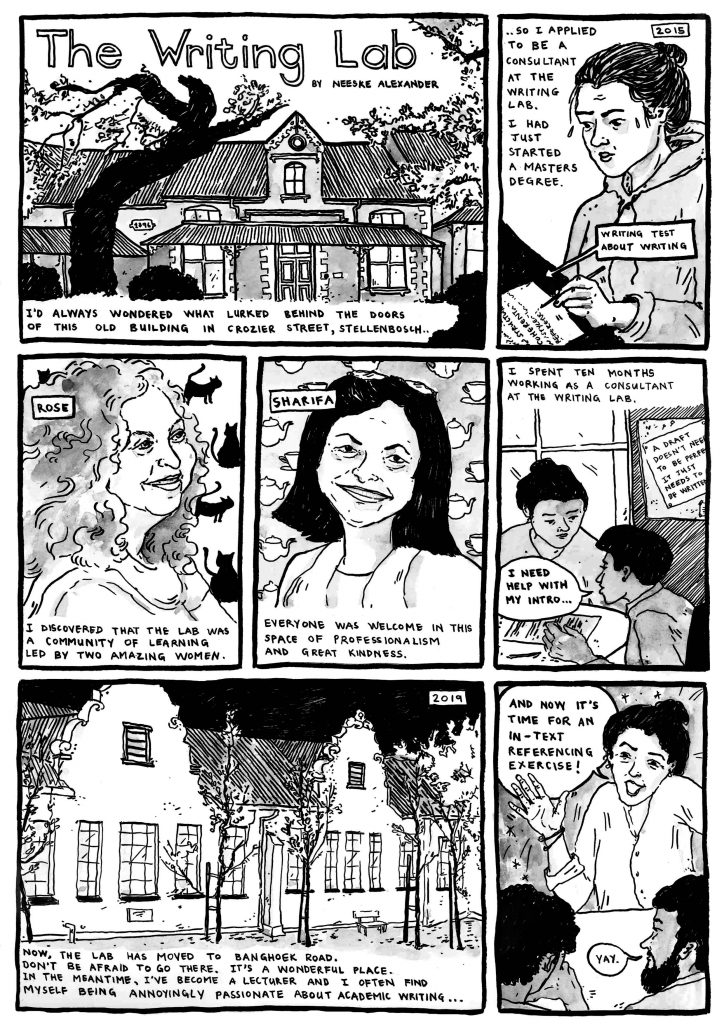
Sharifa Daniels, one of the founding staff members of the Writing Lab of the Language Centre, retired in 2018, after nearly 17 years of service to the writers on campus. We decided to honour her with a special issue of Stellenbosch Papers in Linguistics Plus (SPiL Plus), an accredited open-access journal. The issue is called ‘Space, place, and power in South African writing centres’, since space, place and power are concerns close to Sharifa’s heart, as we explain in our introduction to the issue.
Sharifa often discussed these issues with us when we considered the role of the Writing Lab on campus. Coming from a background that was part of the anti-apartheid struggle, Sharifa saw that it was one thing to admit ‘non-traditional’ students, but quite another matter to help the students to feel part of campus. Before working at the Writing Lab, Sharifa had a long career in secondary education at disadvantaged schools. Here and elsewhere, she witnessed first-hand what happened to people’s lives and educations under apartheid. She also won a scholarship to the University of Iowa where she became interested in writing centres and their social justice possibilities. These are the ideas she brought home and later was able to use at Stellenbosch.
The special issue is the first special issue in the world about South African writing centres. The themes of space, place and power have long been significant in international writing centre work, but have a particular significance in South Africa where our political past and present revolves around how space and place allow power relationships to play out. Writing centres exist to help student writers develop their academic writing identities, but they do this within institutional structures that affect how and why they work.
The special issue has 12 articles and represents seven South African writing centres. It also has seven research notes, written by former Stellenbosch writing consultants whom Sharifa trained. The volume ends with a comic by a former writing consultant who is an artist. She describes the Writing Lab as a community of learning, where everyone was welcome. If you would like to know more about this friendly space, please e-mail or phone Anne-Mari Lackay at 021 808 2928.
The special issue was published as Volume 57(2019) of the accredited journal Stellenbosch Papers in Linguistics Plus (SPiL Plus).
Writing Lab comic by Neeske Alexander, an artist and former writing consultant.
An experiential interpreting workshop – that’s what the research team of the Language Centre’s Interpreting Service came up with this year for the University’s annual Scholarship of Teaching and Learning (SoTL) Conference on 29 and 30 October. Ever wondered about the life and times of an educational interpreter? University staff who attended this workshop signed up to be thrown in at the deep end to interpret in various simulated classroom scenarios. The deep-end scenario had a specific purpose – to give participants an authentic personal experience (with a limited introductory overview) of the demands, emotions and cognitive processes during simultaneous educational interpreting.
Even though participants were supported by experienced SU interpreting buddies, the tension was palpable when Eduard de Kock, the first presenter, fired away in English (at a very reasonable delivery pace) with a history ‘lecture’ to be interpreted to Afrikaans. They gave it their all – the words rolled off their tongues, together with rolling eyes, deep breaths and sighs, the odd nervous giggle and some “whatever” thrown in under the breath when they could not find those elusive equivalents at the speed of light. The lively feedback following the first lecture session included words and phrases like “missing one word made me lose the entire thread”, “the terminology derailed me”, “never realised how difficult it is” and “where do you get the vocabulary from?!”.
Although fun bubbled below the surface throughout the workshop, it was a serious affair. Participants gained a better understanding of the challenges and joys of educational interpreting, the professionalism of the Language Centre’s interpreting team and the importance of interpreting at SU. Interpreting serves as a form of language support, embedded in the SU Language Policy, to assist students who battle to adequately understand the language of delivery in class. By using interpreting they could gain full access to the field of study’s content, capitalise on comprehensive knowledge transfer and benefit from layered meaning creation.
This year, lecturers from the Language Centre, Chemistry and Computer Skills launched a brand new and exciting collaboration project. They joined forces to give extra dimension to the Language Centre’s academic literacy module, Scientific Communication Skills 146, as well as to modules in Chemistry and Computer Skills for students in extended degree programmes in Science, AgriSciences and Engineering.
Students in these modules were given the assignment that they had been appointed by a fictitious government commission to form part of a scientific advisory team that had to investigate and report on a range of relevant topics related to chemistry. The students had to do research in groups and submit a written argument for or against the specific topic. Subsequently the groups had to make their research available to the public by means of five-minute videos in which they communicated their arguments.
The outcomes of this project were the application of reading and writing skills in the context of science in society in general and in South Africa in particular, the development of the ability to choose relevant sources when compiling logical arguments in support of or against a certain issue and, ultimately, to investigate new ways of communicating knowledge to a larger audience.
What made this project even more unique was that students were part of the decision-making process throughout. Right at the beginning, students were given the opportunity to vote for a name for the project. The word ‘phakama’, which means ‘rise up’ in isiXhosa, was chosen as the name. Students were then given the opportunity to identify their own research topics and eventually the students themselves voted for the top video. Topics ranged from nuclear power, genetic modification to adding fluoride to drinking water, a topic which the winning team has explored. The team consisted of Temika Moodley, Jade Opperman, Alliance Sambo and Lukhanye Swapi. Please click here to watch their video.
Students found the project to be innovative and relevant. “The Phakama Project showed me that academics can be both exciting and fun,” was the feedback from one of the students.
We use information collected from cookies and other technologies to improve your user experience and the overall quality of our website. We use anonymous cookies to collect data about how you use our website, so that we can improve and optimise your website experience. For more details, click here.
By clicking 'Accept', you consent to the use of ALL the cookies.
This website uses cookies to improve your experience while you navigate through the website. Out of these, the cookies that are categorized as necessary are stored on your browser as they are essential for the working of basic functionalities of the website. We also use third-party cookies that help us analyze and understand how you use this website. These cookies will be stored in your browser only with your consent. You also have the option to opt-out of these cookies. But opting out of some of these cookies may affect your browsing experience.
Necessary cookies are absolutely essential for the website to function properly. This category only includes cookies that ensures basic functionalities and security features of the website. These cookies do not store any personal information.
Any cookies that may not be particularly necessary for the website to function and is used specifically to collect user personal data via analytics, ads, other embedded contents are termed as non-necessary cookies. It is mandatory to procure user consent prior to running these cookies on your website.