Category: Comms Lab

What has the Language Centre been up to from May to July 2025?

Each quarter, we submit content to be considered for the SU Management Report to Senate and Council. We thought we’d also share here what the Language Centre has been up to during the last quarter (from the beginning of May to the end of July)!

[us_separator]

1. A thriving Stellenbosch University

Promoting institutional multilingualism at SU

Stellenbosch University (SU) is committed to developing and maintaining Western Cape regional languages Afrikaans and isiXhosa as academic languages, and to give support to SASL. Promoting a multilingual mindset among students and staff forms part of the initiative to humanise the institutional culture at SU. Recent activities through the Language Centre during the reporting period are reported on below.


  • Interpreting into three languages available at new Chancellor’s installation
[us_image image=”33423″ size=”us_600_600_crop”][us_separator size=”small”]

SASL, isiXhosa and Afrikaans interpreters at the installation of SU’s new Chancellor.

Interpreting into isiXhosa, Afrikaans and South African Sign Language (SASL) was provided by the Language Centre at the installation of SU’s new Chancellor on 20 June. Lesetja Kganyago, Governor of the South African Reserve Bank, was formally installed as the institution’s 16th Chancellor, and has been serving in the position since January 2025. The installation ceremony took place at Endler Hall.

Interpreting at such high-profile events is an important element in welcoming a multilingual audience and acknowledging the worth of the languages used.

  • Say my name workshop

On 29 May 2025, the Language Centre successfully hosted the Say My Name workshop, attended by staff members from various departments/faculties. This engaging session aimed to create awareness around the importance of correct name pronunciation as a step towards mutual respect in multilingual spaces. Participants shared that the experience was enjoyable and meaningful, with lively interaction throughout. We hope that more staff will benefit from similar sessions in future.

[us_separator size=”small”][us_image image=”33387″ align=”center”]
  • Brand new Afrikaans Stylgids available to everyone at SU

The brand-new Afrikaans US Stylgids, aimed at SU staff and students, was released on 1 July and is available here. It is fitting for the Stylgids to be released in the year in which we celebrate the 100th anniversary of Afrikaans as an official SA language.

The Afrikaans Stylgids is intended as an accessible resource on Afrikaans language usage for the whole of the SU community and anyone else who chooses to use it. The guide aims to ensure that the language we use for the content and communication we provide on behalf of the University is consistent with the image of the University and consonant with our vision and identity as a university. The Stylgids therefore represents guidelines and house rules rather than a comprehensive set of universal grammar rules, and the preferences reflected in the guide are those of the institution.

Like its English counterpart, the SU Style Guide, the Afrikaans Stylgids was commissioned by the Corporate Communication and Marketing Division (CCMD) of the University and compiled by the SU Language Centre in a university-wide consultative process. The Stylgids is meant to be used in combination with the Brand Toolkit, which gives more guidance on the unified SU brand in terms of how we present the University visually and how we speak of it.

[us_separator][us_image image=”33603″ align=”center”][us_separator size=”small”]

A screenshot of a page in the Afrikaans Stylgids.

  • Exploring belonging through language: Staff workshop fosters connection and inclusion at SU

On 17 June, the Language Centre successfully hosted the first Zive usekhaya: Language and Belonging at Stellenbosch University workshop, attended by 15 staff members. This reflective session forms part of the Language Centre’s multilingual mindset series and offered participants a space to explore belonging, language, and identity through storytelling, discussion and beading. The workshop fostered connection, intercultural awareness and meaningful dialogue around inclusion in our multilingual campus culture. Similar workshops are lined up for students later this year to support their experiences of belonging at SU.

[us_separator size=”small”]
[us_image image=”33411″ align=”right”]
[us_image image=”33399″ align=”left”]
[us_image image=”33351″ align=”center”]

2. A transformative student experience


  • SU Language Centre Writing Lab activities during the first semester

The Language Centre’s Writing Lab strives to create a safe, friendly and caring space which provides personal support to students from different faculties and campuses. Between January and May, just over 1 391 writing consultations were conducted. The Writing Lab consults during exam time and vacation periods, during which consultations are primarily with postgraduate writers. Consultations are conducted in-person at the Writing Lab, or online via MS Teams, which accommodates distance students and any other student at the venue of their choice.

During the reporting period, the Writing Lab has had ongoing writing consultation collaborations with the following groups:

  • Agricultural Economics 478 and 781
  • Economics 214
  • Curriculum Studies (Afrikaans Home language 1st and 4th year students) (Education)
  • Entrepreneurship and Innovation Management
  • Political Science 114
  • Technical Communication Skills (Engineering)
  • Scientific Communication Skills (Science, in collaboration with the Language Centre)
  • MBA
  • Sustainable Development
  • Research Assignment 743 (Business Management).


In addition, the Writing Lab worked with lecturers and student writers who make contact independently.

Consultant training happens continuously throughout the year. During May, the Writing Lab collaborated with the Centre for Learning Technologies to explore the topic of artificial intelligence to help consultants to be prepared for consultations with students using AI in their writing. Consultants also study Writing Centre pedagogy and engage with the differences and similarities in various Writing Centres’ methodologies in terms of writing consultations. This sensitises consultants to the different needs of multilingual students from varying educational backgrounds.

Quality was enhanced this year through the use of electronic observation and evaluation forms for easy and effective data capturing. Observations form part of consultant training and involve consultants observing another consultant and giving feedback about their consultations. Student feedback about their consultation experience is used to ensure that students’ and lecturers’ specific needs and expectations are being addressed, and that all student writers and lecturers at SU have a positive experience working with the Writing Lab.

  • Campus Courses

The Language Centre kicked off the year with more than 50 students joining its interactive language courses: Campus isiXhosa and Campus Afrikaans. Offered in a relaxed and engaging environment, the courses are free to all students who are keen to grow their language skills, meet like-minded peers, and join a vibrant network of language learners on campus. Here’s what two of our recent participants had to say: “Being able to hold even a small conversation with isiXhosa speakers has been incredibly rewarding”, and “The energy in class and the positive, supportive atmosphere among new friends who all wanted to learn Afrikaans made the experience truly enjoyable.”

[us_image image=”33339″ size=”us_600_600_crop” align=”left”][us_separator size=”small”]

One of the Campus isiXhosa groups

[us_image image=”33327″ align=”right”][us_separator size=”small”]

Presenter Nika Ndlela with a few of the isiXhosa course participants

  • Expanding access through South African Sign Language

In a significant step toward academic inclusion, the Language Centre, in partnership with the Faculty of Science, provided South African Sign Language (SASL) interpreting for a Deaf Honours student at the ISCB‑Africa ASBCB Conference on Bioinformatics, held from 14 to 17 April 2025, in Cape Town. The event, a gathering of researchers and students in computational biology, offered a rare opportunity for SASL interpreters to engage with specialised scientific terminology and discourse. The interpreting team described the experience as professionally enriching, underscoring the importance of inclusive access to high-level academic content. The Faculty of Science is commended for its proactive commitment to accessibility and for creating space for full academic participation in a highly specialised field.

[us_image image=”33489″]
[us_image image=”33447″]

The Language Centre has offered its South African Sign Language – Beginner Level A1 short course to 13 participants during the first semester. To enable participants who have completed the beginner course to expand their SASL knowledge further, a follow-up short course, South African Sign Language – Elementary Level A2, has been developed this year, and nine participants have completed the first offering.

In addition, a Teach South African Sign Language (SASL): Trainer short course has been developed and will be offered later during year. The course aims to equip first-language SASL users with the knowledge and skills to design, develop and teach a beginner SASL course to a broader audience. It introduces key elements of course creation, including basic structure and analysis, teaching methodology, assessment design and foundational business English.

3. Purposeful partnerships and inclusive networks 

Internationalisation through multilingualism

SU is one of six global partner universities EUTOPIA associates with beyond its core alliance of 10 universities in Europe to create an international gateway for exchanging knowledge and culture. In May, Stellenbosch University was profiled as EUTOPIA’s University of the Month for its contribution to multilingualism through various activities on campus. In the feature article, Dr Kim Wallmach, Director of the Language Centre, comments:

[us_separator]

Stellenbosch – as a town and a campus – is a space where many conversations around identity, belonging and redress, intertwined as always with language, are taking place currently. One of the contributions SU can make […] is to provide a space where students from other countries can experience how a multilingual, yet divided, community is negotiating difference and finding commonalities.”

[us_separator]

The SU Language Centre has worked on developing courses and partnerships to enhance the experiences of international students visiting SU and on building student communities through a multilingual mindset. Some recent initiatives were:


  • University of Georgia Students learn Afrikaans and isiXhosa

In May, the Language Centre had the privilege of hosting a group of 16 students from the University of Georgia (USA) for a short language acquisition course in Afrikaans and isiXhosa. The students thoroughly enjoyed the opportunity to engage with both languages and gain a brief but meaningful introduction to the linguistic and cultural diversity of our region. The Language Centre looks forward to welcoming the University of Georgia again in future and continuing to share the richness of Afrikaans and isiXhosa language and culture with international visitors.

[us_separator size=”small”][us_image image=”33510″ align=”center”]
  • Afrikaans language and culture course for Dutch-speaking students celebrates 10 years

The Language Centre’s celebrated 10 years of language and cultural learning at the end of the first semester this year. This milestone is being celebrated with a series of social media and blog posts shared on the LC’s social media platforms in collaboration with SU International.

[us_image image=”33522″ size=”us_600_600_crop” align=”left”]
[us_image image=”33534″ size=”us_600_600_crop” align=”right”]

A highlight included an interview with Sen Joostens, a former student from Belgium who is currently facilitating Afrikaans language learning at KU Leuven. Over the years, the course has drawn more than 200 students from Belgium and the Netherlands.

  • Stellenbosch University expands its partnerships with Côte d’Ivoire

The Language Centre hosted a group of 28 students from the Institut National Polytechnique Félix Houphouët-Boigny (INP-) INP-HB (Côte d’Ivoire) from 4 July until 1 August. This is the fourth cohort since 2023 and the second cohort for 2025. The students are master’s level students aiming to improve their general and business English skills. Previous students have commented that one of the benefits of coming to SU is the opportunity for immersion, where they are able to use English in everyday interactions in and around Stellenbosch to enhance their communicative competence.

Then, in a new collaboration with the Chamber of Commerce and Industry of Côte d’Ivoire, a group of 9 participants has completed a two-week block of the Intensive English Programme (IEP) at the Language Centre from 4 to 18 July. These students are professionals from the language department from the Chamber of Commerce. This collaboration was initiated by the 1st Secretary (Department of International Relations and Cooperation (DIRCO)) of the South African Embassy in Abidjan, Côte d’Ivoire.


  • Intensive English Programme (IEP) 2025
[us_image image=”33621″ size=”us_600_600_crop”][us_separator size=”small”]

IEP students and their teacher (Ammie) in the classroom

In addition, fifteen international students (from Germany, South Korea, Japan, Madagascar, DRC, Benin, Saudi Arabia, Russia and Italy) enrolled for Intensive English Programme blocks during June and July.

  • Hazendal Wine Estate trilingual creative writing workshops

The Language Centre offered bespoke creative writing workshops in English, Afrikaans, and isiXhosa to a cohort of 15 participants in the first semester on-site at Hazendal wine estate.

One of the main aims of the workshops was to upskill and empower the Hazendal staff at various levels, and to bring the team together.

[us_image image=”33706″ size=”us_600_600_crop”][us_separator size=”small”]

Bongiwe Dlutu (isiXhosa Language Centre presenter) with four of the Hazendal Wine Estate staff participants

[us_separator]

4. Networked and collaborative teaching and learning


  • EQUiiP Summer School fosters growth and inclusivity
[us_image image=”33658″][us_separator size=”small”]

Estelle Meima of the University of Groningen and Vernita Beukes of the SU Language Centre, presenters of the Intercultural Group Dynamics module in the EQUiiP Summer school in Groningen.

Dr Vernita Beukes, a lecturer at the Language Centre, was part of an international panel of five who presented the EQUiiP Summer School at the University of Groningen in the Netherlands from 16 to 20 June this year. The EQUiiP programme is a collaborative summer school that encourages peer learning and sharing teaching practices to professionally develop practitioners. Participants hailed from Iran, Croatia, Latvia, South Africa and the Netherlands, which gave both presenters and participants the opportunity to network with educators from around the world.

The programme explored the concept of internationalising the curriculum, identified effective strategies for creating inclusive classrooms, and developed practical skills on utilising the principles of universal design for learning to meet the diverse needs of students.

The diverse backgrounds and experiences of the participants enriched the discussions and provided multiple perspectives on the challenges and opportunities of internationalising curriculum and creating inclusive classrooms. Collaborative activities and group discussions facilitated the exchange of ideas and best practices, fostering a sense of community and mutual support.

5. Research for impact


The Language Centre does ongoing targeted research to inform best practice.


6. Employer of choice


  • Strengthening intercultural practice in language teaching

Colleagues involved in teaching Afrikaans and isiXhosa at the Language Centre participated in a two-part professional development series focused on the book Developing the Intercultural Dimension in Language Teaching (Council of Europe, 2002). The sessions, held in March and June 2025, created a space for staff to engage critically with foundational concepts and practical strategies for fostering intercultural competence in multilingual classrooms. Presenters and participants reflected on how these ideas resonate within the South African context and shared insights grounded in current teaching practice.


  • Language Centre Comms Lab short course offerings strengthen professional communication at SU

The Language Centre’s Comms Lab has continued its efforts to streamline professional communication at SU during the reporting period. Courses presented include:


[us_image image=”33375″ align=”left”]

The Deputy Director of Internal Communications from the Department of Planning, Monitoring and Evaluation in the Presidency, Tshwane, was one of the participants attending this course. Staff from Student Recruitment, Maties Gymnasium and other environments also attended.

The popular course was presented on 20 and 21 May. A total of 13 participants, six marketing experts from table grape exporter EXSA, and staff from Residence Services, Corporate Communication and Marketing Division, Bureau for Economic Research and the Language Centre, attended the course.

Some feedback: “Excellent course. Surpassed my expectations. Good balance of theory and practical application. Constructive feedback at all times. As facilitator, Eduard created a safe space in which to learn. Perfect and enough to cover the content. There was nothing to fault with this course. Will highly recommend it.”


Five staff members and two external professionals, a medical doctor with her own practice and a senior superintendent from City of CT Municipality, attended this course during May and June. This is what one of our participants had to say:

[us_separator]

Great course, the presenter made everyone feel part and comfortable to share. It gave me confidence and the feedback on assignments were valuable.”

Contributors:

Vernita Beukes
Arné Binneman
Sanet de Jager
Bongiwe Dlutu
Fatima Halday
Christine Joubert
Anne-Mari Lackay
Susan Lotz
Andréa Müller
Helga Sykstus
Kim Wallmach
René Wheeler

[us_separator]
[us_separator]
Tags: , , , ,

ʼn Kykie in van die Taalsentrum se werksaamhede: Mei, Junie en Julie 2025

Ons dien kwartaalliks inligting in vir moontlike plasing in die Universiteit Stellenbosch (US) se Bestuursverslag aan die Senaat en Raad. Ons vertel graag ook hier waarmee die Taalsentrum in die laaste kwartaal, van die begin van Mei tot die einde van Julie, besig was.

[us_separator]

1. ’n Florerende Universiteit Stellenbosch

Die bevordering van institusionele meertaligheid by die US

Die SU het hom daartoe verbind om die Wes-Kaapse streektale, Afrikaans en Xhosa, as akademiese tale te ontwikkel en te onderhou, en om die Suid-Afrikaanse Gebaretaal (SASL) te ondersteun. Die bevordering van ʼn meertalige ingesteldheid onder studente en personeel maak deel uit van die inisiatief om die institusionele kultuur aan die US te vermenslik. Ons doen hier onder verslag oor die Taalsentrum se bedrywighede in die tweede kwartaal van 2026.

  • Tolking in drie tale tydens die nuwe Kanselier se inhuldiging
[us_image image=”33423″ size=”us_600_600_crop”][us_separator size=”small”]

SASL-, Xhosa- en Afrikaanstolke by die inhuldiging van die US se nuwe Kansellier

Die Taalsentrum het tydens die inhuldiging van die US se nuwe Kanselier op 20 Junie tolking in Xhosa, Afrikaans en Suid-Afrikaanse Gebaretaal (SASL) voorsien. Lesetja Kganyago, Goewerneur van die Suid-Afrikaanse Reserwebank, is amptelik ingehuldig as die instansie se 16de Kansellier, nadat hy reeds sedert Januarie 2025 in daardie amp dien. Die inhuldigingseremonie het in die Endlersaal plaasgevind.

Tolking by sulke hoëprofielgeleenthede is ʼn belangrike aspek van die verwelkoming van ʼn meertalige gehoor en van die erkenning van die waarde van die tale wat gebruik word.

  • Say My Name-werksessie

Die Taalsentrum het op 29 Mei 2025 die Say My Name-werksessie, wat deur personeel van verskeie departemente en fakulteite bygewoon is, met groot sukses aangebied. Die doel daarvan was om bewustheid van die korrekte uitspraak van name te verskerp as ʼn stap in die rigting van wedersydse respek in meertalige ruimtes. Die deelnemers het laat weet dat dié ervaring genotvol en betekenisvol was en dat daar deurgaans lewendige deelname was. Ons hoop dat meer personeel in die toekoms by soortgelyke sessies sal baat.

[us_separator size=”small”][us_image image=”33387″ align=”center”]
  • Splinternuwe Afrikaanse Stylgids vir almal by US beskikbaar

Die US se splinternuwe Afrikaanse Stylgids, gemik op US-personeel en studente, is op 1 Julie vrygestel en is hier beskikbaar. Dit is heel gepas dat die Stylgids die lig sien in die jaar waartydens ons die 100ste bestaansjaar van Afrikaans as ʼn amptelike Suid-Afrikaanse taal vier.

Die Stylgids vir Afrikaans is bedoel om ʼn toeganklike hulpbron te wees oor die gebruik van Afrikaans vir die hele US-gemeenskap en enige iemand anders wat dit wil gebruik. Ons hoop dat hierdie gids sal verseker dat die taal wat ons gebruik om namens die Universiteit inligting oor te dra en te kommunikeer, by die US se beeld pas en ooreenstem met ons visie en identiteit as ʼn universiteit. Derhalwe bevat die Stylgids riglyne en interne reëls eerder as ʼn volledige stel universele grammatikareëls, en die voorkeure wat in die Stylgids weerspieël word, is dié van die instansie.

Net soos sy Engelse eweknie, die SU Style Guide, is die Stylgids vir Afrikaans deur die Universiteit se Afdeling Korporatiewe Kommunikasie en Bemarking aangevra en ná ʼn konsultasieproses waarby die hele US betrek is, deur die Taalsentrum saamgestel. Die Stylgids moet saam met die Handelsmerkgereedskapstel gebruik word, wat meer leiding verskaf oor die eenvormige US-handelsmerk se toepassing in die manier waarop ons die Universiteit visueel aanbied en hoe ons daarvan praat.

[us_separator][us_image image=”33603″ align=”center”][us_separator size=”small”]

ʼn Skermskoot van ʼn bladsy in die Stylgids vir Afrikaans

  • Verkenning van geborgenheid deur taal: Personeelwerksessie bevorder verbintenis en insluiting by US

Op 17 Junie het die Taalsentrum die eerste Zive usekhaya: Language and Belonging at Stellenbosch University-werksessie, wat deur 15 personeellede bygewoon is, suksesvol aangebied. Hierdie sessie wat ruimte bied vir nadenke maak deel uit van die Taalsentrum se meertalige ingesteldheid-reeks. Die inisiatief het aan deelnemers ʼn ruimte gebied om hulle tuishoortgevoel te versterk en taal en identiteit te verken deur stories te vertel, en deur besprekings en kralewerk. Die werksessie het verbintenis, interkulturele bewustheid en betekenisvolle dialoogvoering oor insluiting by ons meertalige kampuskultuur bevorder. Soortgelyke werksessies vir studente word vir later vanjaar beplan om hulle ervarings daarvan om by die US tuis te hoort, te versterk.

[us_separator size=”small”]
[us_image image=”33411″ align=”right”]
[us_image image=”33399″ align=”left”]
[us_image image=”33351″ align=”center”]

2. ʼn Transformerende studente-ervaring


  • Die US Taalsentrum se Skryflabaktiwiteite in die eerste semester

Die Taalsentrum se Skryflab het dit ten doel om ʼn veilige, vriendelike omgeeruimte te skep wat persoonlike ondersteuning bied aan studente van verskillende fakulteite en kampusse. Tussen Januarie en Mei het net meer as 1 391 skryfkonsultasies plaasgevind. Die Skryflab konsulteer in eksamentye en gedurende vakansies, wanneer konsultasies hoofsaaklik met nagraadse skrywers is. Konsultasies vind van aangesig tot aangesig in die Skryflab plaas, of aanlyn in MS Teams met afstandstudente en enige ander studente op die plek van hul keuse.

Gedurende die verslagtydperk het die Skryflab deurlopend deur skryfkonsultasies met die volgende groepe saamgewerk:

  • Landbou-ekonomie 478 en 781
  • Ekonomie 214
  • Kurrikulumstudies (Afrikaans Huistaal eerstejaar- en vierdejaarstudente) (Opvoedkunde)
  • Entrepreneurskap en Innoveringsbestuur
  • Politieke Wetenskap 114
  • Tegniese Kommunikasievaardighede (Ingenieurswese)
  • Wetenskaplike Kommunikasievaardighede (Natuurwetenskappe, in samewerking met die Taalsentrum)
  • MBA
  • Volhoubare Ontwikkeling
  • Navorsingsopdrag 743 (Sakebestuur)

Dan het die Skryflab ook gewerk met dosente en studenteskrywers wat onafhanklik navraag gedoen het.

Die Skryflab lei konsultante deurlopend op. In Mei het die Skryflab met die Sentrum vir Leertegnologieë saamgewerk om die konsep van kunsmatige intelligensie (KI) te ondersoek ten einde konsultante te help om voorbereid te wees wanneer hulle konsultasies het met studente wat KI in hulle skryfwerk gebruik. Konsultante bestudeer ook skryfsentrumpedagogiek en die verskille en ooreenkomste tussen verskillende skryfsentrums se metodologieë wat betref skryfkonsultasies. Dit maak konsultante sensitief vir die verskillende behoeftes van meertalige studente uit verskillende opvoedkundige agtergronde.

Gehalte is vanjaar verbeter deur die gebruik van elektroniese waarnemings- en evalueringsvorms vir maklike en effektiewe datavaslegging. Waarnemings maak deel uit van konsultante se opleiding en behels dat konsultante mekaar waarneem en terugvoer oor mekaar se konsultasies gee. Studente se terugvoer oor hul konsultasie-ervarings word gebruik om te verseker dat daar in studente en dosente se spesifieke behoeftes voorsien word, en dat dit vir alle studenteskrywers en dosente aan die US ʼn positiewe ervaring is om met die Skryflab te werk.

  • Kampuskursusse

Die Taalsentrum het die jaar afgeskop met meer as 50 studente wat ingeskryf het vir die interaktiewe taalkursusse, Kampus-Xhosa en Kampusafrikaans. Hierdie kursusse word gratis aangebied vir alle studente wat hulle taalvaardighede graag wil verbeter, en word in ʼn ontspanne en stimulerende omgewing aangebied waar studente enersdenkende eweknieë kan ontmoet en by ʼn dinamiese netwerk van taalleerders op die kampus kan aansluit. Twee van ons onlangse deelnemers het dit só gestel: “Dit was ʼn ongelooflike ervaring om in staat te wees om selfs net ʼn kort gesprekkie met Xhosa-sprekers te voer”, en “Die energie in die klas en die positiewe, ondersteunende atmosfeer tussen nuwe vriende wat almal Afrikaans wil leer, het vir ʼn werklik genotvolle ervaring gesorg.”

[us_image image=”33339″ size=”us_600_600_crop” align=”left”][us_separator size=”small”]

Een van die Kampus-Xhosa-groepe

[us_image image=”33327″ align=”right”][us_separator size=”small”]

Aanbieder Nika Ndlela met ʼn paar van die deelnemers aan die Xhosa-kursus

  • Die uitbreiding van toegang deur Suid-Afrikaanse Gebaretaal

In ’n betekenisvolle stap na akademiese insluiting het die Taalsentrum, in vennootskap met die Fakulteit Natuurwetenskappe, by die ISCB‑Africa ASBCB-konferensie oor Bioinformatika, wat van 14 tot 17 April 2025 in Kaapstad plaasgevind het, tolking in Suid-Afrikaanse Gebaretaal (SASL) voorsien aan ’n Dowe honneursstudent. Hierdie geleentheid, wat navorsers en studente in rekenaarbiologie byeengebring het, het ’n seldsame geleentheid gebied vir SASL-tolke om betrokke te raak by gespesialiseerde wetenskaplike terminologie en diskoers. Die span tolke, wat as van die beste in Suid-Afrika beskou word, het die ervaring as professioneel verrykend beskryf en die belangrikheid van inklusiewe toegang tot akademiese inhoud op hoë vlak beklemtoon. Die Fakulteit Natuurwetenskappe word geloof vir sy proaktiewe toewyding tot toegang en vir die skep van ruimte vir volle akademiese deelname in ’n hoogs gespesialiseerde veld.

[us_image image=”33489″]
[us_image image=”33447″]

Die Taalsentrum het in die eerste semester die -kortkursus vir 13 deelnemers aangebied. Om deelnemers wat die beginnerskursus voltooi het in staat te stel om hul SASL-kennis verder uit te brei, is ’n opvolgkortkursus, SASL – Elementêre vlak A2, vanjaar ontwikkel en nege deelnemers het die eerste aanbieding voltooi.

Nog ʼn kortkursus, die SASL-Opleierskursus, is ontwikkel en sal later vanjaar aangebied word. Dié kursus is daarop gemik om eerstetaalgebruikers van SASL toe te rus met die kennis en vaardighede om ʼn beginnerskursus in SASL vir ’n breër gehoor te ontwerp, te ontwikkel en aan te bied. Dit stel kernkomponente van kursusontwikkeling bekend, met inbegrip van basiese struktuur en analise, onderrigmetodologie, assesseringsontwerp en grondbeginsels van sake-Engels.

3. Doelgerigte vennootskappe en inklusiewe netwerke


Internasionalisering deur meertaligheid

Die US is een van ses wêreldwye vennootuniversiteite waarmee EUTOPIA – buiten sy kernalliansie van tien Europese universiteite – saamwerk om ’n internasionale ruimte vir die uitruil van taal- en kultuurkennis te skep. In Mei is die US aangewys as EUTOPIA se Universiteit van die Maand danksy die instansie se bevordering van meertaligheid deur verskeie aktiwiteite op kampus. In die hoofartikel het dr Kim Wallmach, Direkteur van die Taalsentrum, opgemerk:

[us_separator]

Stellenbosch – as ʼn dorp en as ʼn kampus – is ʼn plek waar baie gesprekke tans plaasvind oor identiteit, ʼn tuishoortgevoel en regstelling; vervleg met taal, soos altyd. Een van die bydraes wat die US kan maak […], is om ʼn ruimte te voorsien waar studente van ander lande kan ervaar hoe ’n meertalige, dog verdeelde, gemeenskap oor verskille onderhandel en ooreenkomste vind.”

[us_separator]

Deur die bevordering van ʼn meertalige ingesteldheid werk die Taalsentrum aan die uitbou van studentegemeenskappe, asook aan die ontwikkeling van kursusse en vennootskappe om die ervarings van internasionale studente wat die US besoek, te verbeter. Onlangse inisiatiewe sluit in:


  • Studente van die Universiteit van Georgia leer Afrikaans en Xhosa

In Mei het die Taalsentrum die voorreg gehad om ʼn groep van 16 studente van die Universiteit van Georgia in die VSA te ontvang vir ʼn kort taalverwerwingskursus in Afrikaans en Xhosa. Die studente het dit terdeë geniet om met dié twee tale om te gaan en ’n kort maar betekenisvolle kennismaking met die taalkundige en kulturele diversiteit van ons streek te beleef. Die Taalsentrum sien uit daarna om die Universiteit van Georgia weer in die toekoms te verwelkom en om die rykdom van Afrikaans en Xhosa – die tale en kulture – verder met internasionale besoekers te deel.

[us_separator size=”small”][us_image image=”33510″ align=”center”]
  • Afrikaanse taal- en kultuurkursus vir Nederlandssprekende studente vier tien jaar

Die Taalsentrum se Afrikaanse taal- en kultuurkursus vir Nederlandssprekende studente het aan die einde van die eerste semester vanjaar tien jaar se taal- en kultuurleer gevier. Hierdie mylpaal word gevier met ʼn reeks sosialemedia- en blogplasings op die Taalsentrum se sosialemediaplatforms in samewerking met US Internasionaal.

[us_image image=”33522″ size=”us_600_600_crop” align=”left”]
[us_image image=”33534″ size=”us_600_600_crop” align=”right”]

ʼn Hoogtepunt was ʼn onderhoud met Sen Joostens, ʼn oudstudent uit België wat studente van die KU Leuven tans ondersteun om Afrikaans te leer. Deur die jare het reeds meer as 200 studente uit België en Nederland die kursus bygewoon.

  • Die Universiteit Stellenbosch brei sy vennootskap met die Ivoorkus uit

Tussen 4 Julie en 1 Augustus het ʼn groep van 28 meestersgraadstudente van die Institut National Polytechnique Félix Houphouët-Boigny (INP-HB) in die Ivoorkus die Taalsentrum besoek. Dit was die vierde groep sedert 2023 en die tweede groep in 2025. Die doel van hulle besoek was om hulle vaardigheid in algemene en sake-Engels te verbeter. Vorige studente het genoem dat een van die voordele van hulle verblyf by die US die geleentheid was om dikwels Engels te praat – hulle kon in hulle daaglikse handel en wandel in en om Stellenbosch Engels praat en sodoende leer om veel beter in Engels te kommunikeer.

As deel van ʼn nuwe samewerkingsooreenkoms met die Kamer van Koophandel van die Ivoorkus sal ʼn groep van nege lede van 4 tot 18 Julie ʼn Intensiewe Engels-program (IEP) van twee weke deurloop. Hierdie studente is professionele lede van die Kamer van Koophandel se taaldepartement, en hierdie ooreenkoms is deur die Eerste Sekretaris van die Departement Internasionale Betrekkinge en Kommunikasie (DIRCO) van die Suid-Afrikaanse Ambassade in Abidjan in die Ivoorkus geïnisieer.


  • Intensiewe Engels-program (IEP) 2025
[us_image image=”33621″ size=”us_600_600_crop”][us_separator size=”small”]

IEP-studente en hulle onderwyser (Ammie) in die klaskamer

Verder het 15 internasionale studente (uit Duitsland, Suid-Korea, Japan, Madagaskar, DRK, Benin, Saudi- Arabië, Rusland en Italië) in Julie ingeskryf vir IEP-blokke.

  • Drietalige kreatieweskryfwerksessies vir personeel van Hazendal-wynlandgoed

In die eerste semester het die Taalsentrum doelgemaakte werksessies vir kreatiewe skryf in Engels, Afrikaans en Xhosa op die Hazendal-wynlandgoed vir ʼn groep van 15 deelnemers aangebied.

Een van die hoofdoelstellings van die werksessies was om die Hazendal-personeel se vaardighede op verskeie vlakke op te skerp en hulle te bemagtig, en om hulle samehorigheidsgevoel as ʼn span te versterk.

[us_image image=”33706″ size=”us_600_600_crop”][us_separator size=”small”]

Bongiwe Dlutu (Xhosa-Taalsentrumaanbieder) met vier van die Hazendal-personeellede wat die sessies bygewoon het

[us_separator]

4. Genetwerkte en samewerkende onderrig

  • EQUiiP-somerskool bevorder groei en insluiting
[us_image image=”33658″][us_separator size=”small”]

Estelle Meima van die Universiteit van Groningen en Vernita Beukes van die SU se Taalsentrum, aanbieders van die Interkulturele Groepsdinamika-module by die EQUiiP-somerskool in Groningen.

Dr Vernita Beukes, ʼn dosent by die Taalsentrum, was een van die vyf lede van ʼn internasionale paneel wat die  EQUiiP-somerskool aan die Universiteit van Groningen van 16 tot 20 Junie vanjaar aangebied het. Die EQUiiP-program is ʼn samewerkende somerskool wat eweknieleer en die deel van onderrigpraktyke aanmoedig vir die professionele ontwikkeling van praktisyns. Deelnemers het van Iran, Kroasië, Letland, Suid-Afrika en Nederland gekom, wat aan sowel aanbieders as deelnemers die geleentheid gebied het om met opvoeders van regoor die wêreld te netwerk.

Die program het gefokus op die internasionalisering van die kurrikulum, die identifisering van effektiewe strategieë om inklusiewe klaskamers te skep, en die ontwikkeling van praktiese vaardighede om die beginsels van universele ontwerp vir leer te gebruik om in studente se uiteenlopende behoeftes te voorsien.

Die uiteenlopende agtergronde en ervarings van die deelnemers het die besprekings verryk en veelvoudige perspektiewe verskaf op die uitdagings en geleenthede in die internasionalisering van leerplanne en die skep van inklusiewe klaskamers. Samewerkende aktiwiteite en groepbesprekings het die uitruil van gedagtes en beste praktyke gefasiliteer, en ʼn gemeenskapsgevoel en wedersydse ondersteuning bevorder.

5. Navorsing vir impak


Die Taalsentrum doen deurlopend geteikende navorsing om beste praktyk toe te pas.


6. Voorkeurwerkgewer


  • Verbetering van interkulturele praktyke in taalonderrig

Kollegas wat betrokke is by die onderrig van Afrikaans en Xhosa by dieTaalsentrum het aan ’n tweedelige professionele ontwikkelingsreeks deelgeneem wat gefokus het op die boek, Developing the Intercultural Dimension in Language Teaching (Council of Europe, 2002). Die sessies, aangebied in Maart en Junie 2025, het ruimte geskep vir personeel om krities in gesprek te tree met grondliggende konsepte en praktiese strategieë om interkulturele bevoegdheid in meertalige klaskamers te bevorder. Aanbieders en deelnemers het nagedink oor hoe hierdie idees met die Suid-Afrikaanse konteks resoneer, en insigte gedeel wat in huidige onderrigpraktyke gegrond is.


  • Taalsentrum se Kommunikasielab-kortkursusse versterk professionele kommunikasie by die US

Die Taalsentrum se Kommunikasielab het in die verslagtydperk voortgegaan met sy werk om professionele kommunikasie aan die US meer vaartbelynd te maak. Een van die kortkursusse wat aangebied is, is:


[us_image image=”33375″ align=”left”]

Die Adjunkdirekteur van Interne Kommunikasie by die Departement van Beplanning, Monitering en Evaluering in die Presidensie, Tshwane, was een van die deelnemers aan hierdie kursus. Personeel van Studentewerwing, Maties Gimnasium en ander omgewings het dit ook bygewoon.

Hierdie gewilde kursus is op 20 en 21 Mei aangebied. ʼn Totaal van 13 deelnemers, ses bemarkingskundiges van die tafeldruifuitvoerder EXSA, en personeel van Koshuisdienste, die Afdeling Korporatiewe Kommunikasie en Bemarking, die Buro vir Ekonomiese Navorsing en die Taalsentrum het dit bygewoon.

Terugvoer wat ontvang is: “Uitstekende kursus wat my verwagtinge oortref het met die goeie balans tussen teorie en praktiese toepassing. Die terugvoer was altyd konstruktief, en as fasiliteerder het Eduard ʼn veilige ruimte geskep waar ons kon leer met genoeg tyd om die inhoud te dek. Ek kon geen fout vind met hierdie kursus nie en beveel dit sterk aan.”


Vyf personeellede en twee eksterne professionele persone, ʼn mediese dokter met haar eie praktyk en ʼn senior superintendent van die Stad Kaapstad se munisipaliteit, het hierdie kursus in Mei en Junie bygewoon. Een van ons deelnemers het die volgende te sê gehad daaroor:

[us_separator]

Uitstekende kursus. Die aanbieder het almal deel van die groep laat voel en dit vir ons maklik gemaak om te deel.  Dit het my selfvertroue gegee, en die terugvoer oor werkopdragte was waardevol.”

Bydraers:

Vernita Beukes
Arne Binneman
Sanet de Jager
Bongiwe Dlutu
Fatima Halday
Christine Joubert
Anne-Mari Lackay
Susan Lotz
Andréa Müller
Helga Sykstus
Kim Wallmach
René Wheeler

[us_separator]
[us_separator]
Tags: , , , ,

Dos and don’ts during online events

Who knew that we all could be so tech savvy? The Covid-19 pandemic and the resulting measures to keep us safe have had many consequences so far. One of the good ones is that ordinary people suddenly manage to do truly amazing things with technology, as long as there is a stable internet connection and a suitable virtual platform. Virtual meetings, online classes and other events on MS Teams, Zoom or similar platforms have entered our lives (and homes) unceremoniously and are likely here to stay.

The Language Centre offers various online events as well – be it courses, seminars or meetings. To ensure that you’re in the know about what is expected of you and what to expect when participating in an online event, we’ve compiled a cheat sheet for you.

When logging on for the session

  • ‘Arrive’ 10 minutes before the start of the session
  • Check your sound settings: your speakers should not be muted
  • When entering the meeting, mute your microphone and turn off your video using the buttons at the bottom of your screen
  • You may want to ‘say hi’ by turning your camera on momentarily and giving a quick wave, but feel free to turn it off until you want to contribute

During the session

Allow yourself to be fully present. Avoid distractions such as social media or e-mail pop-ups. Create a physical space conducive to focusing and participating – consider putting a ‘please do not disturb for the next hour’ sign on your door or desk before the session.

Engage
You have the option to stay ‘invisible’, but sessions are intended for engagement, and questions are always welcome. It’s best not to interrupt the presenter verbally, but you could raise your hand (there’s button for that!) or you could type your question in the text-based chat forum, first, and then reiterate it if there is an opportunity to engage. If your question was not answered during the session, send a personal e-mail to the session presenter afterwards. Usually some questions go unanswered due to sheer volume, not deliberate neglect.

Observe netiquette

  • Be courteous and respectful, and keep your tone polite and conversational
  • Share your own experiences (if relevant)
  • Build on discussions
  • Reply if you have meaningful information
  • Type in complete sentences and clear language
  • Use the @ function to direct a comment or question to someone specifically in the chat. First type ‘@’ and then their name or e-mail address (e.g. ‘I have a similar question to @JaneDoe@sun.ac.za about….’)
  • Be inclusive

Take notes, but…
Make (written or typed) notes of the most critical concepts and possible follow-up questions. Avoid trying to transcribe the session, as it will most likely be recorded and made available after the session.

Tech notes

About the presentation format and the online platforms we use
Online courses will take place on SUNOnline or Microsoft Teams. You will receive an invite via e-mail for each session, probably on the day of the session. Simply click on Join Microsoft Teams Meeting or something similar for other platforms for redirection to a page where you can join on the web (or download the app). If you already have the app, the meeting will open automatically. If not, follow the instructions below to install MS Teams or Zoom. We would recommend installing the applicable app before our live sessions.

About the equipment you need
A smart device (computer, a tablet or a smartphone with internet access) and preferably microphone-enabled headphones are what you need. The garden variety wired earphones that probably came with your smartphone will work just fine.

About your internet connection
You will need a stable internet connection and enough data. Since sessions are live events, your connection speed will influence how well you see and hear a presenter, and whether you experience lags or freezes. To reduce the chances of lags, freezes or failures, rather don’t have multiple web browser tabs (‘windows’) open, and don’t download any files for the time of an event.

How to install Microsoft Teams or Zoom
MS Teams: Go to https://teams.microsoft.com/downloads and click on Download Teams. Follow the prompts to install the app on your computer.
Zoom: Go to https://zoom.us/download#client_4meeting  and download the the first option, namely Zoom Client for Meetings. Follow the prompts to install the app.

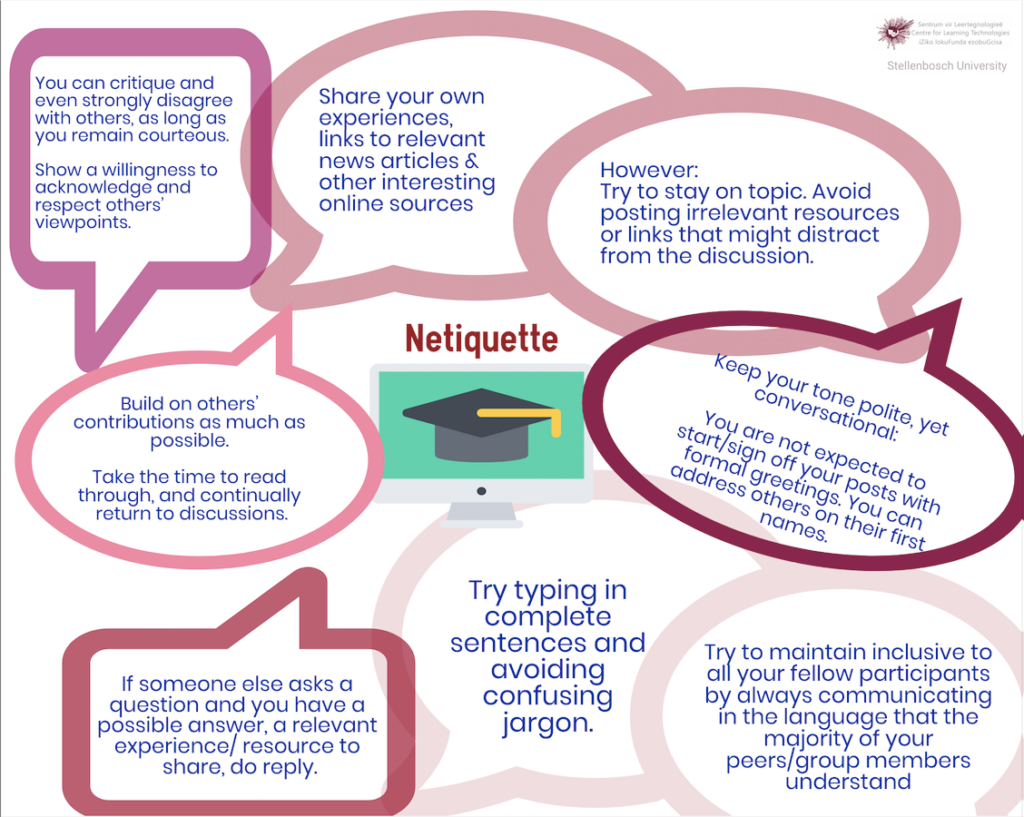
Not sure you know everything about netiquette yet? Click on the infographic for more information:

Thank you to the SU Centre for Learning Technologies for making this information available initially.

So, what does the Language Centre actually do?

The Language Centre is a vibrant hub for students, staff and clients who require language and communication assistance.

One of our most important jobs is to help students speak university. Although academic language is no-one’s mother tongue, you could get by very well once you’ve learnt its ins and outs.

We assist students to get there, in many different language-related ways:

  • We present credit-bearing academic literacies modules in seven of the University’s 10 faculties to equip our students for strategic communication – in an academic setting and in their occupation and industry. Modules focus on professional, business and scientific communication, writing skills and skills for academic discourse.
  • We provide real-time interpreting in lectures – in Afrikaans, English, isiXhosa or South African Sign Language.
  • We’ve created a safe space to discuss one’s writing with a trained writing consultant at our Writing Lab, as well as opportunities to create writing support groups, take part in writing marathons, or attend workshops on writing research proposals, literature reviews, journal articles or other academic writing.
  • We’ve established a Reading Lab that offers workshops, consultations and a visual cognitive processing program to optimise reading.
  • We’ve built a trilingual terminology tool for subject terminology in Afrikaans, English and isiXhosa – try it out here.
  • We present various courses to local and international students aimed at either enhancing skills in a language or acquiring a new language, such as the English for Academic Purposes Programme (EAP) and the Intensive English Programme (IEP), or tailored Afrikaans and isiXhosa We even have a Language Learning Hub for social language learning.

The Language Centre also casts its language and communication assistance net wider than the student community:

  • We offer an editing and translation service in English, Afrikaans and isiXhosa, and we translate into more than 12 other languages. Our services are available to the University, corporate clients and individuals, and we can edit and translate any document – from letters, reports, journal articles and advertisement copy to informed consent forms. In addition, we do transcriptions.
  • We provide an interpreting service at meetings or conferences. We work in Afrikaans, English, isiXhosa and German, but you could speak to us about other language combinations too.
  • We offer language courses aimed at individuals or groups who would like to learn isiXhosa or Afrikaans, or prepare themselves for the International English Language Testing System (IELTS) exam, or who wish to gain the skills to teach English as a foreign language (TEFL).
  • We also present superbly crafted corporate communication short courses through our Comms Lab. Think: effective office documentation, report writing, writing for the media, or crafting confident presentations, to name but a few possibilities.

For us, language creates a transformational space that has the power to change lives, inform policy and unite people. If one of our services or courses appeals to you, speak to us at taalsentrum@sun.ac.za or 021 808 2176.

Great things happen when you work with us!

Tags: , , , , , , , , , , , , , ,

Comms Lab colab with personal assistants

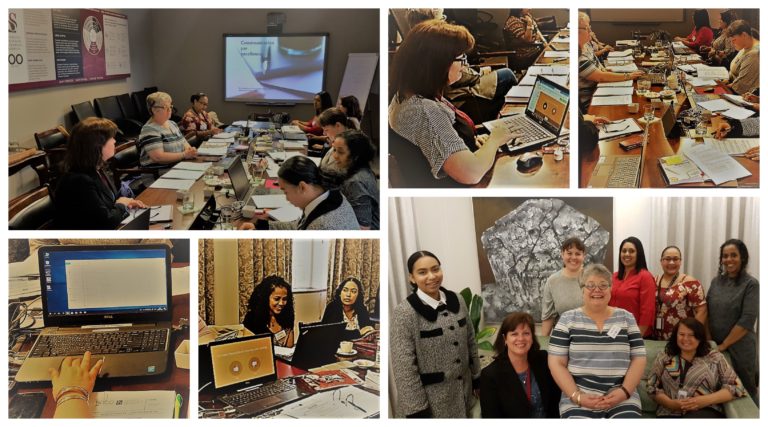
Recently members of the University’s Personal Assistants Network (SUPAN) attended the Language Centre’s Comms Lab Communication par excellence short course, which the Comms Lab tailored to their needs. This is only the first in a series of courses for SUPAN by the Comms Lab – don’t miss out if you’re part of this network!  Speak to Tania Arrison (SUPAN team leader) or Michelle Pieters at the Comms Lab if you’d like to join. Other collaborations are also welcome!

Tags: ,

Comms Lab facilitates public speaking on several platforms

Public speaking is definitely a skill that can be mastered! On 8 August, the Language Centre’s Comms Lab and the Stellenbosch Toastmasters Club joined forces by hosting a demo Toastmasters meeting and information session in the Language Centre Seminar room. This was an opportunity for anyone to see first-hand how the Toastmasters do things: Prepared speeches, evaluations and impromptu speeches were presented in the structured setting of a Toastmasters meeting.

Toastmasters International is a non-profit educational organisation that teaches public speaking and leadership skills through a worldwide network of clubs. Toastmasters is about self-development at one’s own pace in a safe and positive environment. According to the Club’s president, Zimbili Sibiya, “We’re a warm and welcoming bunch and visitors are not obliged to participate in any way other than as observers – you won’t be put on the spot!” Over 30 new faces attended the meeting. If you’d like to attend the next Toastmasters meeting, e-mail them for more information.

The Language Centre’s Comms Lab is always on the look-out for partners – such as Toastmasters – to complement its superbly crafted corporate communication offering. Comms Lab courses are practical and interactive and can be tailored to specific needs. Face-to-face full-day sessions are supplemented by online learning, which creates an ideal advantage and convenient option for busy executives or office administrators. On successful completion of a course, a Certificate of Competence is awarded.

The Comms Lab also aims to build long-term relationships with its participants. “We can see from the number of participants re-enrolling for more of our courses that this is working. To name but a few, we’ve had people from Mediclinic, ICLEI, NKC, the Rupert Foundation, Alphawave, USB and Graham Beck Wines attending courses this year,” Michelle Pieters, Comms Lab coordinator, explains.

“It is always inspiring to see someone develop and reach the next step on their way to full potential. One of our recent stars is Sello Sekele, a young and enthusiastic trainee economist at the Bureau for Economic Research in Stellenbosch.” In August, Sello attended the Comms Lab short course Crafting confident presentations presented by Eduard de Kock, a radio personality, experienced MC and interpreter. “This practical and interactive course helped Sello gain enough confidence and public speaking skills to impress his colleagues to such an extent that one of them phoned me to tell me this!” says Michelle. Well done, Sello!

If you’d like to hone your professional communication skills, speak to Michelle to find out how we can help you.