Tag: TEFL

Meryl’s TEFL adventure

Meryl Davidson completed her TEFL course with the English portfolio at the SU Language Centre and then went on to teach English in South Korea for two years. Meryl’s TEFL qualification allows her to teach English as a foreign language locally and abroad. We asked Meryl a few questions about this enriching experience of travelling and working overseas.

What made you decide to do TEFL?
I decided to do TEFL when I was at a place in my life where I wasn’t finding permanent work in South Africa, I was getting older and needed to sustain myself. I also had a very deep desire to travel, so I thought this was the perfect option for me.

Which doors did your TEFL qualification open for you?
I spent two years teaching English in South Korea. I also travelled the whole Southeast Asia in those two years – something not many people get to say.

I came to see the world from a whole new perspective and it was indeed a life-changing experience. I would not have been able to do this without my TEFL qualification.”

I’m incredibly passionate about travel and surrounding myself with different cultures and traditions. I built lasting friendships and bonds, and I am still in contact with most of the people I met during my time abroad. I also thoroughly enjoyed immersing myself in Asian culture and doing things the way they do. For example, when I came back to South Africa, it was very hard for me NOT to remove my shoes before entering my or anyone else’s home!

In what ways did your TEFL course prepare you for your job?
The TEFL course I did with the SU Language Centre was an incredibly intensive programme that stretched over four weeks. In those four weeks we were prepared for any and every possible classroom scenario that may occur in an English foreign language classroom. Nothing can truly prepare you for life abroad until you experience it for yourself, however, the TEFL course certainly prepared me for what to expect in the classroom in many ways.

Could you share three reasons why you think doing the TEFL course and working abroad is something that one should consider?

  1. There is no feeling more liberating than deciding for something more or different when that is what you truly desire.
  2. It changes you in a way that you cannot begin to imagine. Your thinking, your perspective and your worldview changes. Everything you think you know, disappears.
  3. Your independence is your greatest asset. There is no better way to become independent than by entering the unknown by yourself. Stop letting the world out there be one you only hear of. Go see it for yourself!

Would you like to do a TEFL course?


[us_cta title=”” btn_label=”Read more and apply here” btn_link=”url:https%3A%2F%2Flanguagecentre.sun.ac.za%2Fproduct%2Fteaching-english-as-a-foreign-language-tefl%2F|target:_blank” btn_style=”2″]You’re in luck: our next full-time course starts on 20 November and our next part-time TEFL course starts on 22 January next year, and we still have a place for you. But you’ll have to apply by 10 November for the full-time course, and 20 December for the part-time course. We also have more offerings next year.
Enquiries? Click on the button on the right![/us_cta]
Tags: , , , , ,

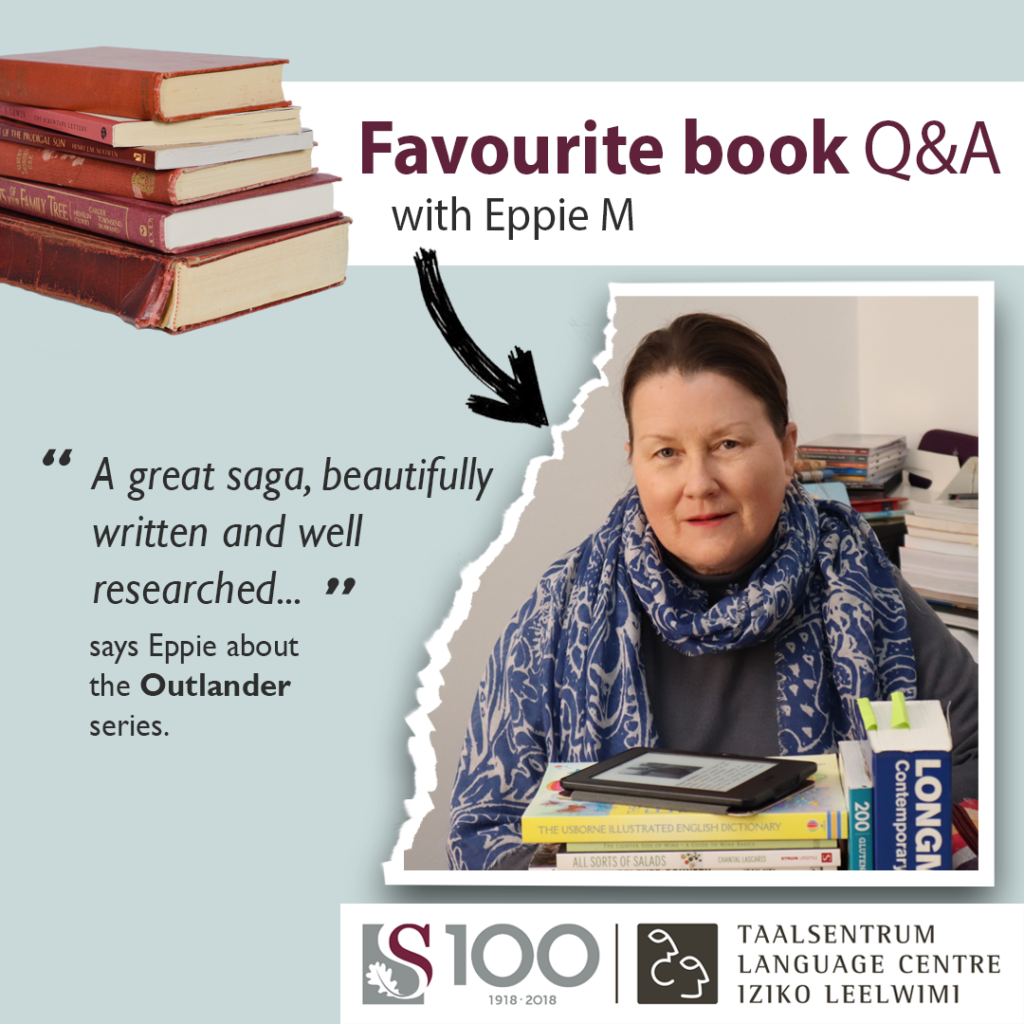
Book chat with Eppie M

Get to know us through the books we read! Every first Friday of the month we’ll share an interview with a Language Centre staff member on a favourite or memorable book.

Eppie McFarlane is a TEFL instructor at the Language Centre and an English as a second language (ESL) teacher. (TEFL is the qualification that enables one to teach English as a foreign language. You can read more about the Language Centre’s TEFL course here.)  

  1. Eppie, what is the title of your favourite book?​
    Outlander
  2. Why is this your favourite book?
    It’s a great saga, beautifully written and well researched – believable.
  3. Who is your favourite author? Also tell us why?  
    Diana Gabaldon at the moment. I’m very taken with her great way of writing and her thorough research.
  4. What are you reading at the moment?​
    The Outlander Series 7-book bundle. I have the eighth book on my Kindle. I am almost finished with book six. We watched the series and I am thoroughly enjoying reading the books.
  5. What book have you re-read? Also tell us why?
    Oh, many! My reading is my escape into a fictional world, so I love good-news stories. I escape into historical fiction as history fascinates me. As long as the English is well written, I will read it. I have read many great modern novels and I enjoy the classics. However I don’t willingly read science fiction, horror, Harry Potter, Lord of the Rings, or watch movies or series about them.
  6. Who is your favourite literary character?
    Currently Claire Beauchamp. Why?​ The way the author has taken the character through the time period that the books span is very interesting.
  7. What book/books would you recommend to your students?​
    This is not an easy question to answer because it depends on the level of students, their interests and what they like reading. Novels are fine for higher-level students (upper intermediate up) but shorter books, including suitable non-fiction works, work really well for lower levels. For example, I love cooking and have many cook books, so I often share recipes and or cookbooks with students and (in a writing exercise) get students to write up their favourite recipes. I have a collection of them. Travel guides also work for lower levels, and other interesting non-fiction books, like information about plants, animals and places where students are staying or where they plan to visit. Poetry seldom works with EFL students (students who are learning English as a foreign language) and comic books are patently unsuccessful too due to the non-literal meanings. I guess what I am saying is that it is a difficult question to answer, and I would address it on a case-by-case or student-by-student manner.
Tags: , , , , , , ,

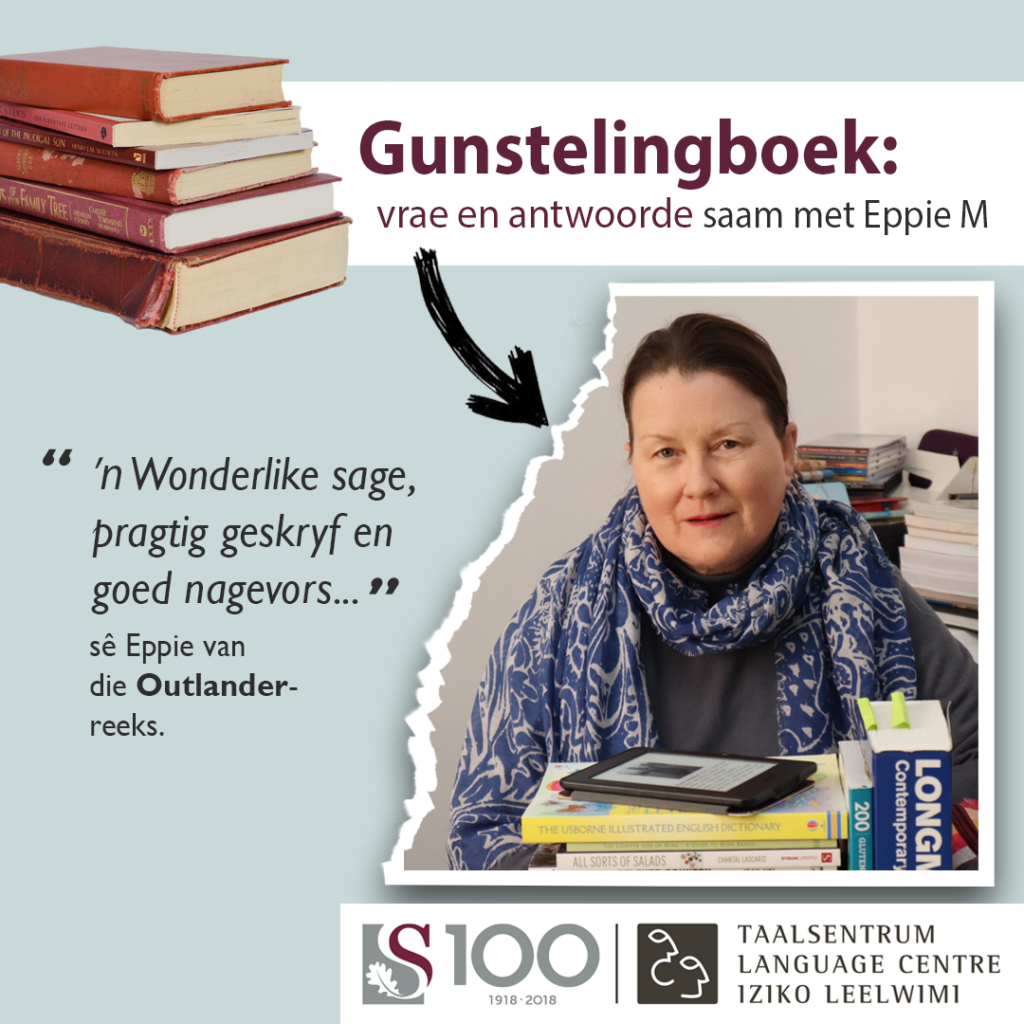
Boekgeselsie met Eppie M

Leer ken ons deur die boeke wat ons ons lees! Elke eerste Vrydag van die maand deel ons ʼn onderhoud met ʼn Taalsentrumpersoneellid oor ʼn gunstelingboek.

Eppie McFarlane is ʼn TEFL-instrukteur by die Taalsentrum en ʼn Engelstweedetaal-onderwyser. (TEFL is die kwalifikasie wat mense in staat stel om onderrig te gee in Engels as vreemde taal. Lees gerus hier meer oor die Taalsentrum se TEFL-kursus.)

  1. Eppie, wat is die titel van jou gunstelingboek?​ Outlander
  2. Hoekom is dit jou gunstelingboek?​ Dis ʼn uitstekende, geloofwaardige sage wat pragtig geskryf en deeglik nagevors is.
  3. Wie is jou gunstelingouteur? Hoe só? Op die oomblik Diana Gabaldon, weens haar uitmuntende skryfstyl en navorsing.
  4. Wat lees jy tans?​ Die boeke van die Outlander 7-reeks. Ek is nou so te sê klaar met die sesde boek en ek het die agtste boek op my Kindle. Ons het na die reeks gekyk en ek geniet dit terdeë om die boeke te lees.
  5. Watter boek het jy al meer as eenkeer gelees? Vertel vir ons hoekom? Ek het al baie boeke herlees. Lees is vir my ontvlugting – ek bevind my vinnig in ʼn fiktiewe wêreld wanneer ek lees, en ek hou van stories wat goeie nuus deel. Omdat geskiedenis my fassineer, ontsnap ek graag na ʼn fiktiewe historiese verhaal. As iets goed geskryf is, sal ek dit lees. Ek het al talle goeie moderne romans gelees en ek geniet klassieke werke, maar ek sal nie uit my eie vrye wil wetenskapsfiksie, gruwelverhale, Harry Potter of Lord of the Rings lees of na flieks of storiereekse oor hulle kyk nie.
  6. Wie is jou gunsteling- literêre karakter? Op die oomblik Claire Beauchamp, want die outeur het haar op ʼn baie interessante manier laat ontwikkel in die tydvak waarin die verhaal afspeel.
  7. Watter boek of boeke sal jy by jou studente aanbeveel?​ Dis ʼn moeilike vraag om te beantwoord omdat dit afhang van die vlak waarop die studente is, hulle belangstellings, en die soort boeke wat hulle graag lees. Romans kan werk vir studente op ʼn hoër vlak (gevorderde intermediêr en hoër) maar dunner boeke, ook geskikte niefiksieboeke, is geskik vir laervlakstudente. Ek is byvoorbeeld lief daarvoor om kos te maak en ek deel dikwels resepte en kookboeke met my studente. Ek vra hulle ook om hulle gunstelingresepte neer te skryf – ek het al ʼn hele versameling resepte! Reisgidse kan vir die laer vlakke gebruik word, asook ander interessante niefiksieboeke, soos dié wat handel oor plante, diere en plekke waar die studente woon of wat hulle van plan is om te besoek. Poësie werk gewoonlik nie vir EVT-studente (studente wat besig is om Engels as ʼn vreemde taal te leer) nie, en strokiesprentverhale uiteraard ook nie, omdat alles nie uitgespel word nie. Dit kom daarop neer dat ʼn mens nie kan veralgemeen nie. Ek sou eerder leesstof aanbeveel as ek weet vir wie spesifiek, omdat studente sulke uiteenlopende behoeftes het.
Tags: , , , , , , , , , ,